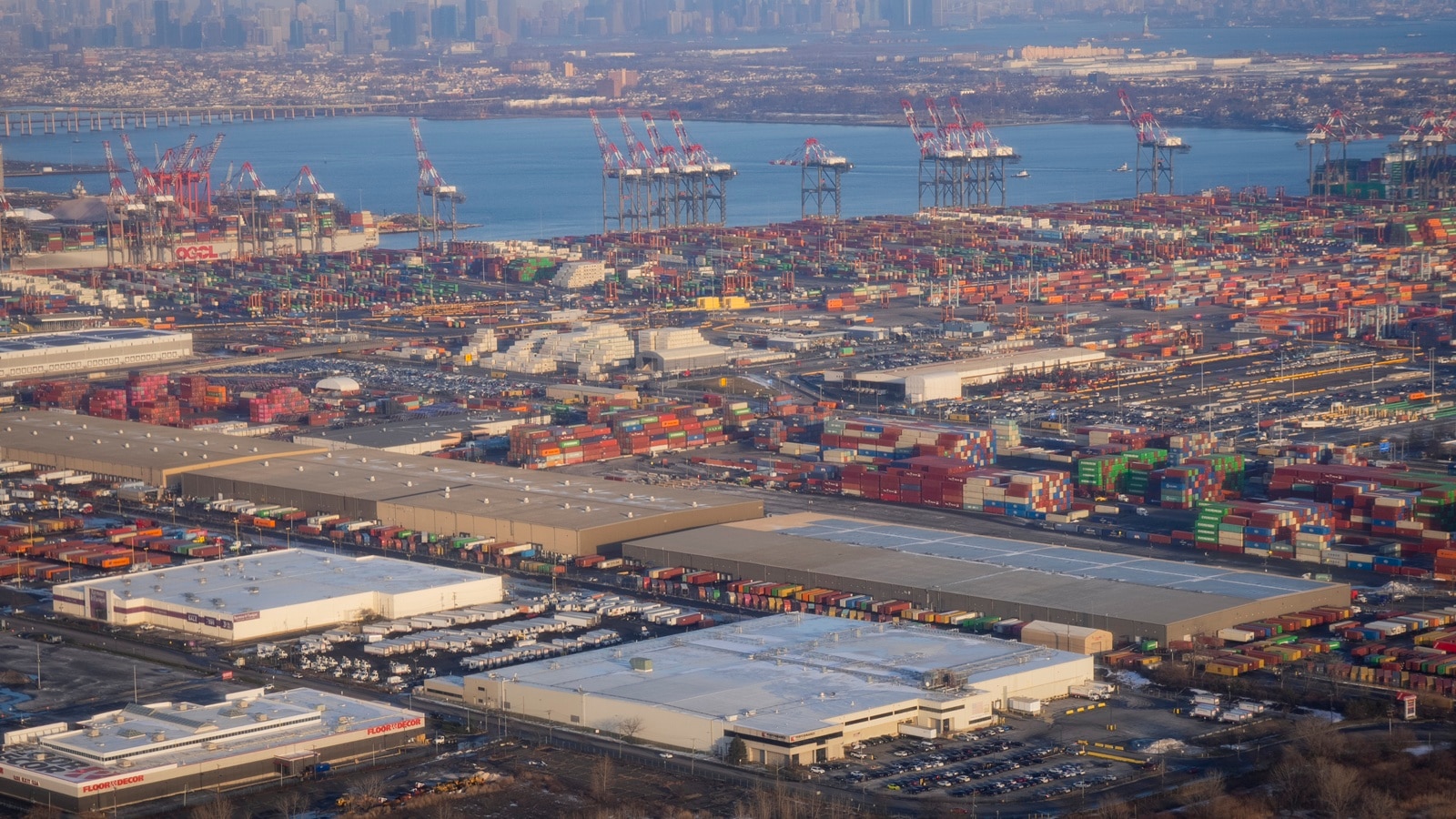


Globalization faces its next crisis
Companies that import products into the United States, the world’s largest economy, are grappling with confusion over the future of Trump’s tariffs after the Supreme Court ruled that he had breached his presidential authority.
Written by Peter S. Goodman
Thousands of miles from the attacks in the Middle East, at his company’s headquarters in Toronto, Amar Zaidi confronted what is normally a straightforward logistical task. He needed to ship fabric from a mill in Istanbul to a customer in Shanghai.
But the usual route involved passing through Oman via the Suez Canal — a pathway suddenly fraught with danger. The price of booking a container ship was soaring.
Zaidi’s company, Rebus International, makes yarn and textiles, supplying raw materials to international clothing brands including Calvin Klein and Hugo Boss. Before the war in the Persian Gulf, transporting a container from Turkey to China cost about $2,000, he said. When he tried to book the journey this week, carriers demanded surcharges that multiplied the price to $10,000.
“It’s chaos,” said Zaidi, 52, who has worked in the industry for three decades. “It’s the ripple effect. Everything is blamed on the war.”
Fabric is probably not the first item that springs to mind on the list of cargo waylaid by war. Wildly fluctuating prices for oil and natural gas are the most obvious manifestation, a result of the effective shutdown of the Strait of Hormuz, the channel linking the Persian Gulf to the rest of the planet.
But the consequences of upending commerce in much of the Middle East are far broader, and increasingly apparent in industries beyond energy. From industrial commodities to tropical fruit, products needed in one place are getting stuck somewhere else. The longer the hostilities persist, the greater the upheaval for shoppers and businesses throughout the global economy.
The reverberations amount to a rebuke of the notion that globalization is history, a claim popularized by nationalist movements on multiple continents.
President Donald Trump has pursued a trade war in the name of forcing factory production back to the United States. China and India have pursued versions of self-sufficiency. Yet the war in the Middle East has highlighted the enduring reality of global economic integration. Supply chains are not only intact but expanding, heightening the risks when the movement of goods is interrupted.
“Every time we get one of these disruptions, we have these predictions that it’s the end of globalization,” said Steven A. Altman, a globalization expert at New York University’s Stern School of Business and co-author of a recent study on the continued expansion of trade and investment across borders. “The narrative is different from the reality.”
The turmoil of the COVID-19 pandemic revealed how bottlenecks in shipping can trigger cascading troubles. A floating traffic jam off a port in Southern California strands chemicals needed to make paint in Delaware. It ties up containers that could otherwise be used to load cargo in China, delaying exports of electronics destined for Ireland and pushing up the price of moving cargo everywhere.
Such realizations prompted companies to highlight commitments to “supply chain resilience” alongside their usual devotion to efficiency. Retailers like Walmart shifted manufacturing from Asia to Mexico, shrinking the distance between factories and customers to limit their vulnerability to the hazards of global commerce.
But the push toward more regional trade appears to be reversing, according to Altman’s report.
From 2020 to 2023, the share of American imports arriving from Mexico and Canada increased to 29%, from 26%. But over the first nine months of 2025, it dipped to 27%.
As the pandemic fades into memory, international companies have returned to seeking the lowest-cost suppliers of goods, wherever they may be.
And as the Trump administration dismantles federal programs aimed at increasing renewable sources of energy like solar and wind power, the nation is more exposed to the implications of higher prices for oil and gas.
All of which means that the halting of marine traffic through the Persian Gulf is likely to spread dysfunction widely.
The most immediate crisis centers on energy. Tankers have been attacked. Oil facilities have been shut down. The war has delivered “the largest supply disruption in the history of the global oil market,” the International Energy Agency declared Thursday.
Not even the concerted release of oil reserves by 30 nations could prevent the price of oil from again breaching $100 a barrel. The prospect of a sustained increase in energy prices has economists warning of the potential for stagflation, a term coined to describe the impact of shocks in the 1970s: stagnant economic growth and higher prices.
Higher energy prices make fuel more expensive for trucks, tankers and jets, increasing the costs of moving cargo. Larger bills for gasoline and air-conditioning leave households with less money to spend on goods and experiences — a drag on economic growth.
Companies that import products into the United States, the world’s largest economy, are grappling with confusion over the future of Trump’s tariffs after the Supreme Court ruled that he had breached his presidential authority.
“We have created equal if not greater uncertainty parameters than during the pandemic,” said Nick Vyas, a supply chain expert at the University of Southern California’s Marshall School of Business. “It’s a perfect storm for stagflation.”
In Southeast Asia, producers of shrimp and tropical fruit now struggle to transport their wares to Europe and North America. From India to Indiana, farmers are confronting higher prices for fertilizer because of the disruption to stocks produced in the Persian Gulf. The price of aluminum is climbing, given impediments to shipments from Qatar and Bahrain. Helium, a critical element for making computer chips, could soon become scarce.
“This is not just an oil story,” Vyas said. “This is an industrial supply story.”
The Gulf is a dominant source of urea, the leading form of nitrogen fertilizer. Making it requires ammonia, which is produced with natural gas. So long as energy production is hampered, the ability to make fertilizers will be constrained. Urea prices have already climbed significantly.
If farmers economize in their use of fertilizer, that could reduce harvests, diminishing the supply of food and pushing prices higher. In vulnerable countries in sub-Saharan Africa and South Asia, that could lead to greater malnutrition.
At the center of concern is disruption to shipping lanes and air cargo hubs in the Persian Gulf.
With planes unable to land and refuel at major airports in Dubai and Doha on trips between Europe and Asia, they have had to reroute, often over Central Asia. That has lengthened journeys, requiring more fuel. And that has forced carriers to limit how much cargo they carry.
The cost of airfreight from Asia to Europe has doubled since the beginning of the war. Vietnam to the United States has increased by nearly half. That has challenged the ability of American automakers and retailers to secure electronics and components.
“Freight rates are more volatile,” said Chloe Lee at Olympia Express, a freight forwarding company in Ho Chi Minh City, Vietnam. “Many Vietnamese exporters are becoming more cautious about booking shipments.”
This is the time of year when major importers tend to negotiate yearlong contracts with ocean carriers. Container shipping prices have been relatively cheap because of a glut of new vessels entering the market. But now ocean carriers are absorbing the likelihood that fuel prices will be significantly higher just as some routes are impeded by the war.
“It’s certainly just one thing after another in this industry,” said Ryan Petersen, CEO of Flexport, a global logistics company.
For the shipping realm, the latest conflict in the Gulf is unfolding just as the last one appeared to be fading — the strikes on ships entering the Red Sea by Houthi rebels. Vessels moving between Europe and Asia had been avoiding that corridor, instead traveling the long way around Africa.
In recent months, ships had been returning to the Red Sea. Not anymore.
With ships again looping around Africa on trips between Europe and Asia, carriers are affixing fees and lifting prices.
That was the situation confronting Zaidi and his Canadian textile company this week.
He tried to ship a load of fabric to England from Pakistan. The carriers said they could not locate shipping containers. The steel boxes were scattered at ports around the Indian Ocean, held in place by the shutdown of marine traffic through the Middle East.
“I’m ready to pay whatever it costs, and I don’t have containers available for the next three weeks,” Zaidi said.
His company tried to ship 10 containers of machinery to Pakistan from Durban, South Africa. It had already booked the journey at a price of $2,500 per box. The carrier suddenly lifted the rate to $4,800. The route required a much longer run to Singapore.
The further out Zaidi contemplated, the greater his concern grew.
If the shipping crisis persists, cotton harvested in China may arrive late to Pakistan, delaying his production of yarn. Mills that weave fabric in Indonesia will struggle to find raw materials. Making clothing will get harder.
“Prices will go up,” he said.
This article originally appeared in The New York Times.
Stay updated with the latest - Click here to follow us on Instagram
Written by Peter S. Goodman
Thousands of miles from the attacks in the Middle East, at his company’s headquarters in Toronto, Amar Zaidi confronted what is normally a straightforward logistical task. He needed to ship fabric from a mill in Istanbul to a customer in Shanghai.
But the usual route involved passing through Oman via the Suez Canal — a pathway suddenly fraught with danger. The price of booking a container ship was soaring.
Zaidi’s company, Rebus International, makes yarn and textiles, supplying raw materials to international clothing brands including Calvin Klein and Hugo Boss. Before the war in the Persian Gulf, transporting a container from Turkey to China cost about $2,000, he said. When he tried to book the journey this week, carriers demanded surcharges that multiplied the price to $10,000.
“It’s chaos,” said Zaidi, 52, who has worked in the industry for three decades. “It’s the ripple effect. Everything is blamed on the war.”
Fabric is probably not the first item that springs to mind on the list of cargo waylaid by war. Wildly fluctuating prices for oil and natural gas are the most obvious manifestation, a result of the effective shutdown of the Strait of Hormuz, the channel linking the Persian Gulf to the rest of the planet.
But the consequences of upending commerce in much of the Middle East are far broader, and increasingly apparent in industries beyond energy. From industrial commodities to tropical fruit, products needed in one place are getting stuck somewhere else. The longer the hostilities persist, the greater the upheaval for shoppers and businesses throughout the global economy.
The reverberations amount to a rebuke of the notion that globalization is history, a claim popularized by nationalist movements on multiple continents.
President Donald Trump has pursued a trade war in the name of forcing factory production back to the United States. China and India have pursued versions of self-sufficiency. Yet the war in the Middle East has highlighted the enduring reality of global economic integration. Supply chains are not only intact but expanding, heightening the risks when the movement of goods is interrupted.
“Every time we get one of these disruptions, we have these predictions that it’s the end of globalization,” said Steven A. Altman, a globalization expert at New York University’s Stern School of Business and co-author of a recent study on the continued expansion of trade and investment across borders. “The narrative is different from the reality.”
The turmoil of the COVID-19 pandemic revealed how bottlenecks in shipping can trigger cascading troubles. A floating traffic jam off a port in Southern California strands chemicals needed to make paint in Delaware. It ties up containers that could otherwise be used to load cargo in China, delaying exports of electronics destined for Ireland and pushing up the price of moving cargo everywhere.
Such realizations prompted companies to highlight commitments to “supply chain resilience” alongside their usual devotion to efficiency. Retailers like Walmart shifted manufacturing from Asia to Mexico, shrinking the distance between factories and customers to limit their vulnerability to the hazards of global commerce.
But the push toward more regional trade appears to be reversing, according to Altman’s report.
From 2020 to 2023, the share of American imports arriving from Mexico and Canada increased to 29%, from 26%. But over the first nine months of 2025, it dipped to 27%.
As the pandemic fades into memory, international companies have returned to seeking the lowest-cost suppliers of goods, wherever they may be.
And as the Trump administration dismantles federal programs aimed at increasing renewable sources of energy like solar and wind power, the nation is more exposed to the implications of higher prices for oil and gas.
All of which means that the halting of marine traffic through the Persian Gulf is likely to spread dysfunction widely.
The most immediate crisis centers on energy. Tankers have been attacked. Oil facilities have been shut down. The war has delivered “the largest supply disruption in the history of the global oil market,” the International Energy Agency declared Thursday.
Not even the concerted release of oil reserves by 30 nations could prevent the price of oil from again breaching $100 a barrel. The prospect of a sustained increase in energy prices has economists warning of the potential for stagflation, a term coined to describe the impact of shocks in the 1970s: stagnant economic growth and higher prices.
Higher energy prices make fuel more expensive for trucks, tankers and jets, increasing the costs of moving cargo. Larger bills for gasoline and air-conditioning leave households with less money to spend on goods and experiences — a drag on economic growth.
Companies that import products into the United States, the world’s largest economy, are grappling with confusion over the future of Trump’s tariffs after the Supreme Court ruled that he had breached his presidential authority.
“We have created equal if not greater uncertainty parameters than during the pandemic,” said Nick Vyas, a supply chain expert at the University of Southern California’s Marshall School of Business. “It’s a perfect storm for stagflation.”
In Southeast Asia, producers of shrimp and tropical fruit now struggle to transport their wares to Europe and North America. From India to Indiana, farmers are confronting higher prices for fertilizer because of the disruption to stocks produced in the Persian Gulf. The price of aluminum is climbing, given impediments to shipments from Qatar and Bahrain. Helium, a critical element for making computer chips, could soon become scarce.
“This is not just an oil story,” Vyas said. “This is an industrial supply story.”
The Gulf is a dominant source of urea, the leading form of nitrogen fertilizer. Making it requires ammonia, which is produced with natural gas. So long as energy production is hampered, the ability to make fertilizers will be constrained. Urea prices have already climbed significantly.
If farmers economize in their use of fertilizer, that could reduce harvests, diminishing the supply of food and pushing prices higher. In vulnerable countries in sub-Saharan Africa and South Asia, that could lead to greater malnutrition.
At the center of concern is disruption to shipping lanes and air cargo hubs in the Persian Gulf.
With planes unable to land and refuel at major airports in Dubai and Doha on trips between Europe and Asia, they have had to reroute, often over Central Asia. That has lengthened journeys, requiring more fuel. And that has forced carriers to limit how much cargo they carry.
The cost of airfreight from Asia to Europe has doubled since the beginning of the war. Vietnam to the United States has increased by nearly half. That has challenged the ability of American automakers and retailers to secure electronics and components.
“Freight rates are more volatile,” said Chloe Lee at Olympia Express, a freight forwarding company in Ho Chi Minh City, Vietnam. “Many Vietnamese exporters are becoming more cautious about booking shipments.”
This is the time of year when major importers tend to negotiate yearlong contracts with ocean carriers. Container shipping prices have been relatively cheap because of a glut of new vessels entering the market. But now ocean carriers are absorbing the likelihood that fuel prices will be significantly higher just as some routes are impeded by the war.
“It’s certainly just one thing after another in this industry,” said Ryan Petersen, CEO of Flexport, a global logistics company.
For the shipping realm, the latest conflict in the Gulf is unfolding just as the last one appeared to be fading — the strikes on ships entering the Red Sea by Houthi rebels. Vessels moving between Europe and Asia had been avoiding that corridor, instead traveling the long way around Africa.
In recent months, ships had been returning to the Red Sea. Not anymore.
With ships again looping around Africa on trips between Europe and Asia, carriers are affixing fees and lifting prices.
That was the situation confronting Zaidi and his Canadian textile company this week.
He tried to ship a load of fabric to England from Pakistan. The carriers said they could not locate shipping containers. The steel boxes were scattered at ports around the Indian Ocean, held in place by the shutdown of marine traffic through the Middle East.
“I’m ready to pay whatever it costs, and I don’t have containers available for the next three weeks,” Zaidi said.
His company tried to ship 10 containers of machinery to Pakistan from Durban, South Africa. It had already booked the journey at a price of $2,500 per box. The carrier suddenly lifted the rate to $4,800. The route required a much longer run to Singapore.
The further out Zaidi contemplated, the greater his concern grew.
If the shipping crisis persists, cotton harvested in China may arrive late to Pakistan, delaying his production of yarn. Mills that weave fabric in Indonesia will struggle to find raw materials. Making clothing will get harder.
“Prices will go up,” he said.
This article originally appeared in The New York Times.