

Spurred by his mother’s knee pain, this Hyderabad pharmacist built a wearable for chronic pain relief
Curapod is a wearable light therapy device that uses photobiomodulation to treat chronic pain conditions such as arthritis, sciatica, and frozen shoulder, with no side effects.
“I remember when my mother and her friends went on a pilgrimage,” recalls Surya Maguluri, co-founder and CTO of Litemed. “While everyone else walked around easily, my mother could only join them later in the day because she was in so much pain. It kept getting worse to the point where she couldn’t climb stairs and had to rely entirely on the elevator.”
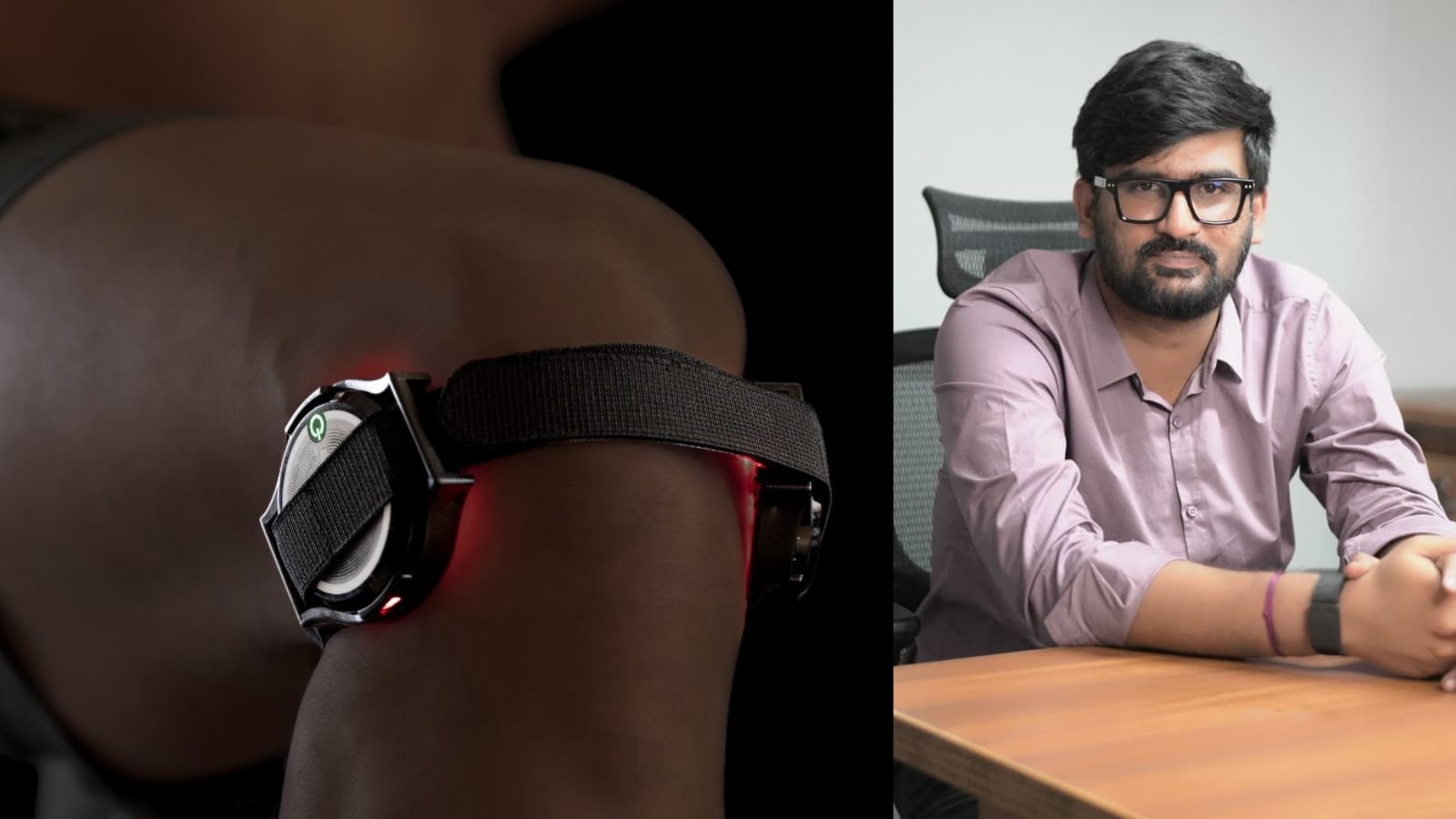
His mother’s debilitating knee pain became the driving force behind the development of Curapod, a wearable light-therapy device designed for chronic pain relief.
Founded by Maguluri and Sriram Velliyur, the Hyderabad-based med-tech startup has sold over 30,000 Curapod units in the past 12 to 15 months. To date, the devices have been used in more than 200,000 recorded pain management sessions.
Maguluri says his mother’s pain initially made him create a solution, but his perspective changed completely after he began interacting with more people living with chronic pain.
“For a person who stands for six to ten hours a day, it creates a lot of pressure on the knees,” he told indianexpress.com. “A lot of corporate employees also have to sit for long hours, which impacts their backs and overall well-being. These stories told me enough about how we could transform the pain management industry. That was the first step in the thought process of bringing Curapod to the market.
Maguluri, 31, who holds a Doctor of Pharmacy degree from Jawaharlal Nehru Technological University, describes Curapod as a compact, light-based device that offers safe, daily relief from chronic pain without any adverse side effects.
“With chronic pain, many people simply suppress the symptoms by taking a painkiller and continue with their daily activities,” said Maguluri. “Many people don’t realise what this is actually doing to their bodies over time, and because pain medication is so easily accessible, many people rely on it without fully understanding the long-term consequences.”
Curapod is about the size of a five-rupee coin, measuring just 4.8 cm in diameter. “Initially, we developed a much bulkier device and tested it with users. The feedback we received was that it wasn’t comfortable to wear, and a lot of light was leaking. We then tweaked the optical design, made the device smaller, and improved the way the light was dispersed,” he said.
Maguluri says he was inspired by how Fitbit changed the wearable technology market long before Apple launched the Apple Watch and made fitness devices mainstream. Maguluri further added that, just as Fitbit, Apple, and more recently Whoop have made people more conscious of their health through wearable technology, Curapod aims to achieve something similar in the therapeutic space.
“We are creating a device within the same wearable ecosystem, allowing people to use the product themselves and directly experience its benefits,” he said.
Curapod uses Photobiomodulation (PBM), a technique that stimulates the body’s natural healing processes with light. PBM therapy works by shining red LED light on a specific area of the body for a short period. The light penetrates injured or inflamed tissues, helping improve blood circulation in the affected area. Increased blood flow can reduce inflammation and helps lower your pain level and heal wounds.
Maguluri claims that a 30-minute Curapod session can offer up to 60 per cent relief for conditions such as arthritis, sciatica, and frozen shoulder. The device automatically shuts off after each 30-minute session to avoid overuse. Each charge provides two sessions, totalling 60 minutes of working time.
As Maguluri has explicitly stated, Curapod is a pain relief device, not a cure or a replacement for medical treatment. He advises users not to stop ongoing physiotherapy. The idea is to use it as a “complementary therapy” alongside physiotherapy or medication, with the aim of reducing dependence on painkillers.
Work on Curapod began in 2022, and it took one and a half to two years to bring the device to market. During this time, Curapod had to undergo clinical trials and got as many as seven safety certifications before it was introduced in 2024.
Curapod is classified as a certified “medical device” and is registered with India’s Central Drugs Standard Control Organisation (CDSCO). The device can be used manually and with the application, which tracks the number of sessions and records pain scores over time, comparing previous and current results. However, the data needs to be manually entered by the user.
Curapod, which retails for Rs 8,399 in India, is targeted at people aged 45 and above who are suffering from chronic pain. In fact, Maguluri noted that 60 per cent of Curapod customers are women over 60, indicating that joint pain and knee issues are more prevalent among older women in India. The device is also popular among corporate workers aged 35 and above who experience long hours of standing or sitting. What surprised Maguluri was that usage of Curapod is higher among men aged 30 to 45.
Maguluri, however, notes that the user profile and buyer profile differ. In most cases, the buyers are sons and daughters purchasing Curapod for their parents or grandparents.
Once a customer purchases Curapod, a company representative arranges a virtual demo of how the device works. After one week, they follow up with the customer, and after a month or so, the company gets in touch again to check on the user’s product usage.
Maguluri says the company has so far not experienced any adverse skin effects among its users after using the Curapod. He assures that the device has multiple certifications, including IEC 62471 for photobiological safety. It also complies with biocompatibility and domestic electronics safety standards (IEC 60601-1). That being said, if there is slight redness on a user’s skin, it typically subsides within 24 to 30 minutes.
Curapod is designed and manufactured in India at the company’s factory in Hyderabad. “During the selection of components and development, we did face some issues related to design aspects. But while scaling up, we haven’t faced issues because the entire electronics distribution ecosystem in India is extremely well developed,” says Maguluri.
For Maguluri, the team developed the prototype alongside the entire production and validation process, including PCB assembly and testing. Throughout development, Maguluri and team continuously figured out the issues and refined both the product and the process. “It’s a constant evolution,” says Maguluri. “In the next one or two years, you can expect the best manufactured electronics devices from India.”
Maguluri’s Litemed operates primarily as a direct-to-consumer brand, with Curapod being sold via the company’s website. However, the company has recently conducted a small pilot to sell Curapod through an online marketplace. Curapod is also available via Apollo Pharmacy. That being said, Maguluri is looking to strengthen its B2B sales focus. He cites the association with PhysioPlus, which has over 1,000 physiotherapy centres across India. The focus is also on working closely with elder care centres such as Khyaal, a premier digital club and physical community for senior citizens in India.
In the coming months, the company has plans to launch Curapod in the US and European markets. Maguluri says a small pilot in the US is planned for this year, with a full launch targeted for the next financial year. The company is currently going through the certification formalities in the US.
Like smartphones and other connected devices, Maguluri sees Curapod being upgraded over time, and R&D is already underway on the next version internally. He did not reveal the details.
The med-tech ecosystem is growing fast, and the way the market for health wearables and devices is evolving is benefiting startups like his. Maguluri explains that the med-tech market is growing rapidly. He used continuous glucose monitoring (CGM) as an example of how diabetes care has shifted from a difficult diagnosis to a manageable lifestyle condition. He believes that pain management is on a similar path and is emerging as a fast-growing market.
While many startup founders regard India as a difficult market in which to grow startups and introduce new innovations, Maguluri has a different take. He cites T-Hub in Hyderabad, an incubator that offers funding, mentorship, and exposure, which has helped accelerate the development of Curapod.
Hyderabad is fast becoming a hub for startups and a preferred destination for American tech companies to expand their campuses and GCCs.
Maguluri adds that he has not faced any challenges in finding the right talent in Hyderabad. “What we do is let every product development person first work at the factory and then move them into product development, because that’s when they understand exactly what we are trying to build,” he said, adding that the average age group is between 28 and 29, and that many of them hold BTech and MTech degrees.
Maguluri employs over 60 people at his company. There are no plans to raise additional funds, as he is currently focused on scaling operations before pursuing major future funding rounds.
“I remember when my mother and her friends went on a pilgrimage,” recalls Surya Maguluri, co-founder and CTO of Litemed. “While everyone else walked around easily, my mother could only join them later in the day because she was in so much pain. It kept getting worse to the point where she couldn’t climb stairs and had to rely entirely on the elevator.”
His mother’s debilitating knee pain became the driving force behind the development of Curapod, a wearable light-therapy device designed for chronic pain relief.
Founded by Maguluri and Sriram Velliyur, the Hyderabad-based med-tech startup has sold over 30,000 Curapod units in the past 12 to 15 months. To date, the devices have been used in more than 200,000 recorded pain management sessions.
Maguluri says his mother’s pain initially made him create a solution, but his perspective changed completely after he began interacting with more people living with chronic pain.
“For a person who stands for six to ten hours a day, it creates a lot of pressure on the knees,” he told indianexpress.com. “A lot of corporate employees also have to sit for long hours, which impacts their backs and overall well-being. These stories told me enough about how we could transform the pain management industry. That was the first step in the thought process of bringing Curapod to the market.
Maguluri, 31, who holds a Doctor of Pharmacy degree from Jawaharlal Nehru Technological University, describes Curapod as a compact, light-based device that offers safe, daily relief from chronic pain without any adverse side effects.
“With chronic pain, many people simply suppress the symptoms by taking a painkiller and continue with their daily activities,” said Maguluri. “Many people don’t realise what this is actually doing to their bodies over time, and because pain medication is so easily accessible, many people rely on it without fully understanding the long-term consequences.”
Curapod is about the size of a five-rupee coin, measuring just 4.8 cm in diameter. “Initially, we developed a much bulkier device and tested it with users. The feedback we received was that it wasn’t comfortable to wear, and a lot of light was leaking. We then tweaked the optical design, made the device smaller, and improved the way the light was dispersed,” he said.
Maguluri says he was inspired by how Fitbit changed the wearable technology market long before Apple launched the Apple Watch and made fitness devices mainstream. Maguluri further added that, just as Fitbit, Apple, and more recently Whoop have made people more conscious of their health through wearable technology, Curapod aims to achieve something similar in the therapeutic space.
“We are creating a device within the same wearable ecosystem, allowing people to use the product themselves and directly experience its benefits,” he said.
Curapod uses Photobiomodulation (PBM), a technique that stimulates the body’s natural healing processes with light. PBM therapy works by shining red LED light on a specific area of the body for a short period. The light penetrates injured or inflamed tissues, helping improve blood circulation in the affected area. Increased blood flow can reduce inflammation and helps lower your pain level and heal wounds.
Maguluri claims that a 30-minute Curapod session can offer up to 60 per cent relief for conditions such as arthritis, sciatica, and frozen shoulder. The device automatically shuts off after each 30-minute session to avoid overuse. Each charge provides two sessions, totalling 60 minutes of working time.
As Maguluri has explicitly stated, Curapod is a pain relief device, not a cure or a replacement for medical treatment. He advises users not to stop ongoing physiotherapy. The idea is to use it as a “complementary therapy” alongside physiotherapy or medication, with the aim of reducing dependence on painkillers.
Work on Curapod began in 2022, and it took one and a half to two years to bring the device to market. During this time, Curapod had to undergo clinical trials and got as many as seven safety certifications before it was introduced in 2024.
Curapod is classified as a certified “medical device” and is registered with India’s Central Drugs Standard Control Organisation (CDSCO). The device can be used manually and with the application, which tracks the number of sessions and records pain scores over time, comparing previous and current results. However, the data needs to be manually entered by the user.
Curapod, which retails for Rs 8,399 in India, is targeted at people aged 45 and above who are suffering from chronic pain. In fact, Maguluri noted that 60 per cent of Curapod customers are women over 60, indicating that joint pain and knee issues are more prevalent among older women in India. The device is also popular among corporate workers aged 35 and above who experience long hours of standing or sitting. What surprised Maguluri was that usage of Curapod is higher among men aged 30 to 45.
Maguluri, however, notes that the user profile and buyer profile differ. In most cases, the buyers are sons and daughters purchasing Curapod for their parents or grandparents.
Once a customer purchases Curapod, a company representative arranges a virtual demo of how the device works. After one week, they follow up with the customer, and after a month or so, the company gets in touch again to check on the user’s product usage.
Maguluri says the company has so far not experienced any adverse skin effects among its users after using the Curapod. He assures that the device has multiple certifications, including IEC 62471 for photobiological safety. It also complies with biocompatibility and domestic electronics safety standards (IEC 60601-1). That being said, if there is slight redness on a user’s skin, it typically subsides within 24 to 30 minutes.
Curapod is designed and manufactured in India at the company’s factory in Hyderabad. “During the selection of components and development, we did face some issues related to design aspects. But while scaling up, we haven’t faced issues because the entire electronics distribution ecosystem in India is extremely well developed,” says Maguluri.
For Maguluri, the team developed the prototype alongside the entire production and validation process, including PCB assembly and testing. Throughout development, Maguluri and team continuously figured out the issues and refined both the product and the process. “It’s a constant evolution,” says Maguluri. “In the next one or two years, you can expect the best manufactured electronics devices from India.”
Maguluri’s Litemed operates primarily as a direct-to-consumer brand, with Curapod being sold via the company’s website. However, the company has recently conducted a small pilot to sell Curapod through an online marketplace. Curapod is also available via Apollo Pharmacy. That being said, Maguluri is looking to strengthen its B2B sales focus. He cites the association with PhysioPlus, which has over 1,000 physiotherapy centres across India. The focus is also on working closely with elder care centres such as Khyaal, a premier digital club and physical community for senior citizens in India.
In the coming months, the company has plans to launch Curapod in the US and European markets. Maguluri says a small pilot in the US is planned for this year, with a full launch targeted for the next financial year. The company is currently going through the certification formalities in the US.
Like smartphones and other connected devices, Maguluri sees Curapod being upgraded over time, and R&D is already underway on the next version internally. He did not reveal the details.
The med-tech ecosystem is growing fast, and the way the market for health wearables and devices is evolving is benefiting startups like his. Maguluri explains that the med-tech market is growing rapidly. He used continuous glucose monitoring (CGM) as an example of how diabetes care has shifted from a difficult diagnosis to a manageable lifestyle condition. He believes that pain management is on a similar path and is emerging as a fast-growing market.
While many startup founders regard India as a difficult market in which to grow startups and introduce new innovations, Maguluri has a different take. He cites T-Hub in Hyderabad, an incubator that offers funding, mentorship, and exposure, which has helped accelerate the development of Curapod.
Hyderabad is fast becoming a hub for startups and a preferred destination for American tech companies to expand their campuses and GCCs.
Maguluri adds that he has not faced any challenges in finding the right talent in Hyderabad. “What we do is let every product development person first work at the factory and then move them into product development, because that’s when they understand exactly what we are trying to build,” he said, adding that the average age group is between 28 and 29, and that many of them hold BTech and MTech degrees.
Maguluri employs over 60 people at his company. There are no plans to raise additional funds, as he is currently focused on scaling operations before pursuing major future funding rounds.