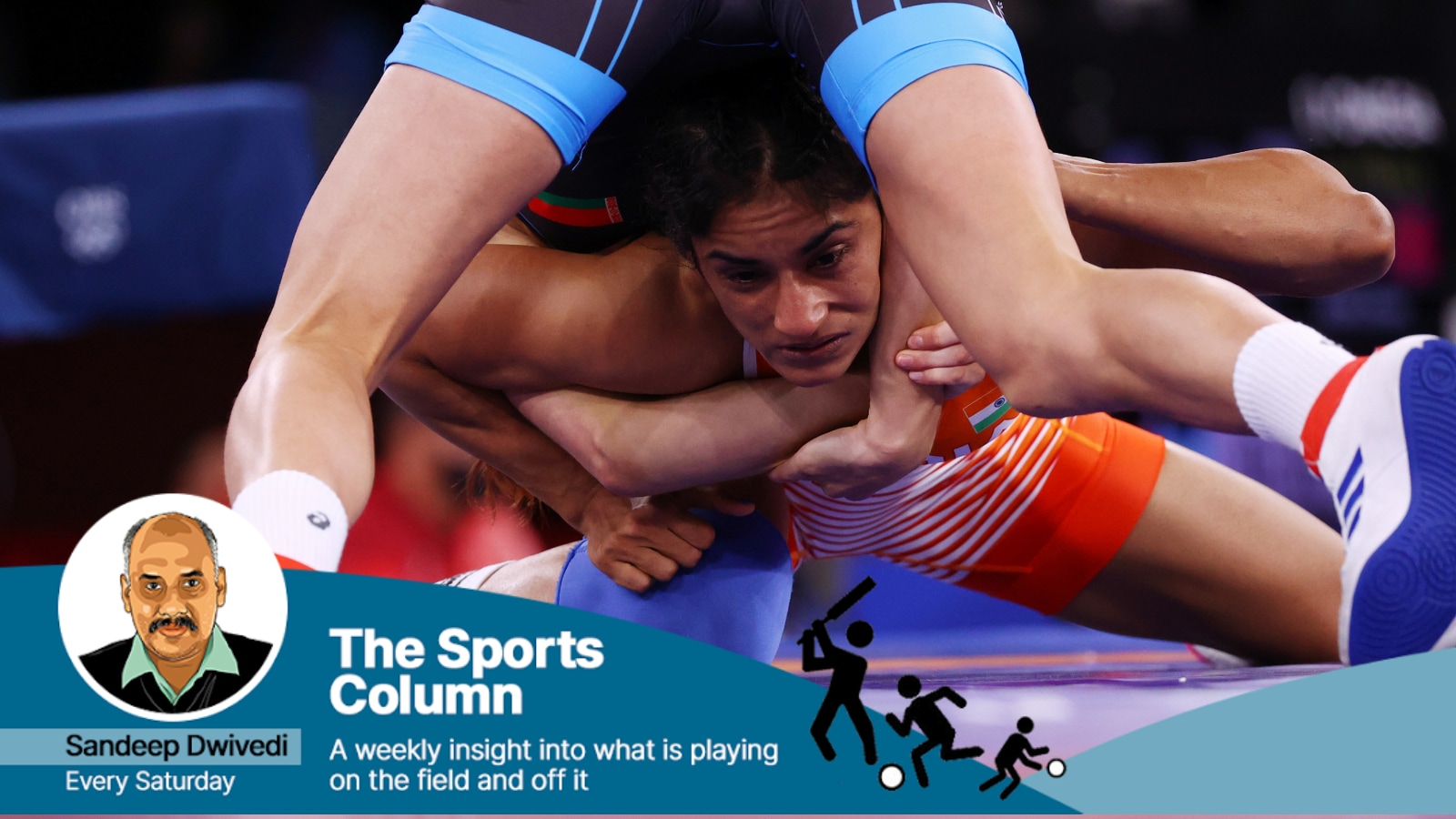


Vinesh Phogat vs wrestling system, and sadly the champion is on the mat
WFI is undermining a competitor who has redefined the sport in the country with her passion, intensity and achievements. Is this the case of revenge served cold?
On that traumatic night before her gold-medal bout at the 2024 Olympics, a desperate Vinesh Phogat pleaded with the doctor to draw some blood out of her body. She had spent half an hour inside a 98 degree Celsius sauna, but sweat beads hadn’t surfaced on her severely dehydrated body. The coaches had cut her hair, even shortened her singlet, but still she weighed 57.1 kg — the stubborn extra 100 grams that eventually led to her disqualification weren’t being shed.
Blood, sweat, a potential medical complication and even the possibility of permanent internal organ damage — Vinesh had risked everything to have a shot at a gold medal and history. She wasn’t going to let her country down. She would get sympathy and praise. The all-time great American wrestler Jordan Burroughs said Vinesh deserved a silver medal and that the weight rule needed to change.
India’s top table tennis star Manika Batra would get emotional. “You’ve shown us what it means to chase dreams with passion and grace. India is proud to call you its own, and we’re blessed to witness your journey,” she posted on social media.
Vinesh would get overwhelming public support, but not from those designated to give her the shoulder and be her shield in times of crisis. Those governing the sport that has historically celebrated quick moves and sharp reflexes, the Wrestling Federation of India (WFI), almost two years after their star wrestler’s unfortunate disqualification from the Paris Olympics, would pull her up for an alleged embarrassing act that only they saw.
ALSO READ | Why Vinesh Phogat is accusing Wrestling Federation of India of ‘deliberately’ blocking her comeback
“Your failure to manage your weight in the highest international competition… resulted in the loss of an assured Olympic medal for India and caused lasting reputational damage to Indian wrestling,” WFI told Vinesh in a 15-page show-cause notice days before she was to take her first step on the mat after the Olympic slip-up.
Firm believers in “revenge is best served cold” in Mario Puzo’s works would have blown smoke rings in appreciation and stood up and bowed.
The timing was immaculate. With that WFI statement, irony didn’t just die, it was strangled in full public view, with no remorse.
Around the Paris Olympics, “the lasting reputational damage to Indian wrestling” was clearly done by the then-WFI chief and BJP MP Brij Bhushan Sharan Singh. Six woman wrestlers had levelled allegations of sexual harassment against him — a dubious first in Indian sports. The chargesheet mentioned grave sections — 354 and 354A. The court, too, would frame the charges. In plain English, the judge had thought that there was sufficient material for a trial to commence.
Vinesh was the face of the turbulent protest against Brij Bhushan at Jantar Mantar in New Delhi. She, along with other Indian Olympian wrestlers, had alternately slept in tents and under the stars, inside mosquito nets, and also outside. At the peak of the protest, when the wrestlers planned a march to Parliament, they were dragged on the streets.
The frame of Vinesh and Olympic medallist Sakshi Malik braving the cops’ batons, sprawled on the floor, would be splashed on the front pages of newspapers around the world.
Those disturbing images from that dramatic day best captured the protest, the insensitivity of those who don’t miss a chance to ride the sporting bandwagon, and the helplessness of world-conquering athletes. The wrestlers were eventually detained and driven out of the capital. The protest, for all its moral force, had been physically extinguished.
But the images had already travelled. By nightfall, they were everywhere — on television, on phones, in living rooms across India. A country that had cheered these same athletes to Olympic podiums was now watching them being detained on a public street. The establishment had won the day. But it had also handed the wrestlers something more durable than a news cycle — a symbol.
Vinesh, on her comeback two years after the devastating Paris disqualification, made it clear that bygones weren’t bygones. The WFI, now run by Brij Bhushan’s old aide Sanjay Singh, had scheduled the tournament of her return in Gonda, Brij Bhushan’s territory.
Now a Congress MLA and mother of a 10-month-old son, Vinesh had to make a fresh start. But she hadn’t forgotten
the past. Between spending time with her toddler, training hard and being a politician, she was regularly attending hearings in court in the Brij Bhushan case. With the spotlight back on her, she told the media that she didn’t feel safe in Gonda. She also made a revelation: Vinesh alleged that she wasn’t just a complainant but also one of Brij Bhushan’s victims.
ALSO READ | WFI a dictatorship… they are afraid I will win medals again: Vinesh in Gonda
Within days, she got the show-cause notice with a long list of charges. She was asked to explain a missed dope test. The World Anti-Doping Agency gives athletes the provision to miss three tests — but WFI wanted answers, and never mind that the incident was several months old. At the Paris Olympics trials, why did she compete in two weight categories?
The answer was simple — because she was allowed to do so by those in control of WFI then. Besides, someone who had lost trust in the system didn’t want to take chances. So what, WFI was suddenly in a mood to ask questions.
There were other dope-related charges, but none had been flagged by or found worthy of sanctions by the international anti-doping agencies. WFI also threw tangled red tape around her. They said she needed to reply in 14 days, and a soon-to-be-named committee would look into the matter.
In a nutshell, Vinesh couldn’t compete, ruling her out of the Asian Games in September. She is a sprinter by nature — she shows the passion to fly off the track, but finds hurdles placed in front of her.
WFI should have verified facts before drafting the show-cause notice. To understand what WFI is undermining, it helps to understand what Vinesh did in Paris before Paris undid her. Japan’s legend Yui Susaki had not lost a single international bout in her career — an unblemished 82-0 record. She was, by any measure, the best female wrestler on the planet in that category.
Vinesh dismantled her. It was not a scrambled, fortunate win — it was a statement, the kind that rewrites how a nation thinks about itself in a sport. India had not seen anything quite like it. Her feral rage and killer instinct — a characteristic unseen in most Indian athletes — had built a reputation for her as a new-age modern wrestler and for this country of many ancient akhadas. That is what WFI is casually grinding underfoot.
On that traumatic night before her gold-medal bout at the 2024 Olympics, a desperate Vinesh Phogat pleaded with the doctor to draw some blood out of her body. She had spent half an hour inside a 98 degree Celsius sauna, but sweat beads hadn’t surfaced on her severely dehydrated body. The coaches had cut her hair, even shortened her singlet, but still she weighed 57.1 kg — the stubborn extra 100 grams that eventually led to her disqualification weren’t being shed.
Blood, sweat, a potential medical complication and even the possibility of permanent internal organ damage — Vinesh had risked everything to have a shot at a gold medal and history. She wasn’t going to let her country down. She would get sympathy and praise. The all-time great American wrestler Jordan Burroughs said Vinesh deserved a silver medal and that the weight rule needed to change.
India’s top table tennis star Manika Batra would get emotional. “You’ve shown us what it means to chase dreams with passion and grace. India is proud to call you its own, and we’re blessed to witness your journey,” she posted on social media.
Vinesh would get overwhelming public support, but not from those designated to give her the shoulder and be her shield in times of crisis. Those governing the sport that has historically celebrated quick moves and sharp reflexes, the Wrestling Federation of India (WFI), almost two years after their star wrestler’s unfortunate disqualification from the Paris Olympics, would pull her up for an alleged embarrassing act that only they saw.
ALSO READ | Why Vinesh Phogat is accusing Wrestling Federation of India of ‘deliberately’ blocking her comeback
“Your failure to manage your weight in the highest international competition… resulted in the loss of an assured Olympic medal for India and caused lasting reputational damage to Indian wrestling,” WFI told Vinesh in a 15-page show-cause notice days before she was to take her first step on the mat after the Olympic slip-up.
Firm believers in “revenge is best served cold” in Mario Puzo’s works would have blown smoke rings in appreciation and stood up and bowed.
The timing was immaculate. With that WFI statement, irony didn’t just die, it was strangled in full public view, with no remorse.
Around the Paris Olympics, “the lasting reputational damage to Indian wrestling” was clearly done by the then-WFI chief and BJP MP Brij Bhushan Sharan Singh. Six woman wrestlers had levelled allegations of sexual harassment against him — a dubious first in Indian sports. The chargesheet mentioned grave sections — 354 and 354A. The court, too, would frame the charges. In plain English, the judge had thought that there was sufficient material for a trial to commence.
Vinesh was the face of the turbulent protest against Brij Bhushan at Jantar Mantar in New Delhi. She, along with other Indian Olympian wrestlers, had alternately slept in tents and under the stars, inside mosquito nets, and also outside. At the peak of the protest, when the wrestlers planned a march to Parliament, they were dragged on the streets.
The frame of Vinesh and Olympic medallist Sakshi Malik braving the cops’ batons, sprawled on the floor, would be splashed on the front pages of newspapers around the world.
Those disturbing images from that dramatic day best captured the protest, the insensitivity of those who don’t miss a chance to ride the sporting bandwagon, and the helplessness of world-conquering athletes. The wrestlers were eventually detained and driven out of the capital. The protest, for all its moral force, had been physically extinguished.
But the images had already travelled. By nightfall, they were everywhere — on television, on phones, in living rooms across India. A country that had cheered these same athletes to Olympic podiums was now watching them being detained on a public street. The establishment had won the day. But it had also handed the wrestlers something more durable than a news cycle — a symbol.
Vinesh, on her comeback two years after the devastating Paris disqualification, made it clear that bygones weren’t bygones. The WFI, now run by Brij Bhushan’s old aide Sanjay Singh, had scheduled the tournament of her return in Gonda, Brij Bhushan’s territory.
Now a Congress MLA and mother of a 10-month-old son, Vinesh had to make a fresh start. But she hadn’t forgotten
the past. Between spending time with her toddler, training hard and being a politician, she was regularly attending hearings in court in the Brij Bhushan case. With the spotlight back on her, she told the media that she didn’t feel safe in Gonda. She also made a revelation: Vinesh alleged that she wasn’t just a complainant but also one of Brij Bhushan’s victims.
ALSO READ | WFI a dictatorship… they are afraid I will win medals again: Vinesh in Gonda
Within days, she got the show-cause notice with a long list of charges. She was asked to explain a missed dope test. The World Anti-Doping Agency gives athletes the provision to miss three tests — but WFI wanted answers, and never mind that the incident was several months old. At the Paris Olympics trials, why did she compete in two weight categories?
The answer was simple — because she was allowed to do so by those in control of WFI then. Besides, someone who had lost trust in the system didn’t want to take chances. So what, WFI was suddenly in a mood to ask questions.
There were other dope-related charges, but none had been flagged by or found worthy of sanctions by the international anti-doping agencies. WFI also threw tangled red tape around her. They said she needed to reply in 14 days, and a soon-to-be-named committee would look into the matter.
In a nutshell, Vinesh couldn’t compete, ruling her out of the Asian Games in September. She is a sprinter by nature — she shows the passion to fly off the track, but finds hurdles placed in front of her.
WFI should have verified facts before drafting the show-cause notice. To understand what WFI is undermining, it helps to understand what Vinesh did in Paris before Paris undid her. Japan’s legend Yui Susaki had not lost a single international bout in her career — an unblemished 82-0 record. She was, by any measure, the best female wrestler on the planet in that category.
Vinesh dismantled her. It was not a scrambled, fortunate win — it was a statement, the kind that rewrites how a nation thinks about itself in a sport. India had not seen anything quite like it. Her feral rage and killer instinct — a characteristic unseen in most Indian athletes — had built a reputation for her as a new-age modern wrestler and for this country of many ancient akhadas. That is what WFI is casually grinding underfoot.