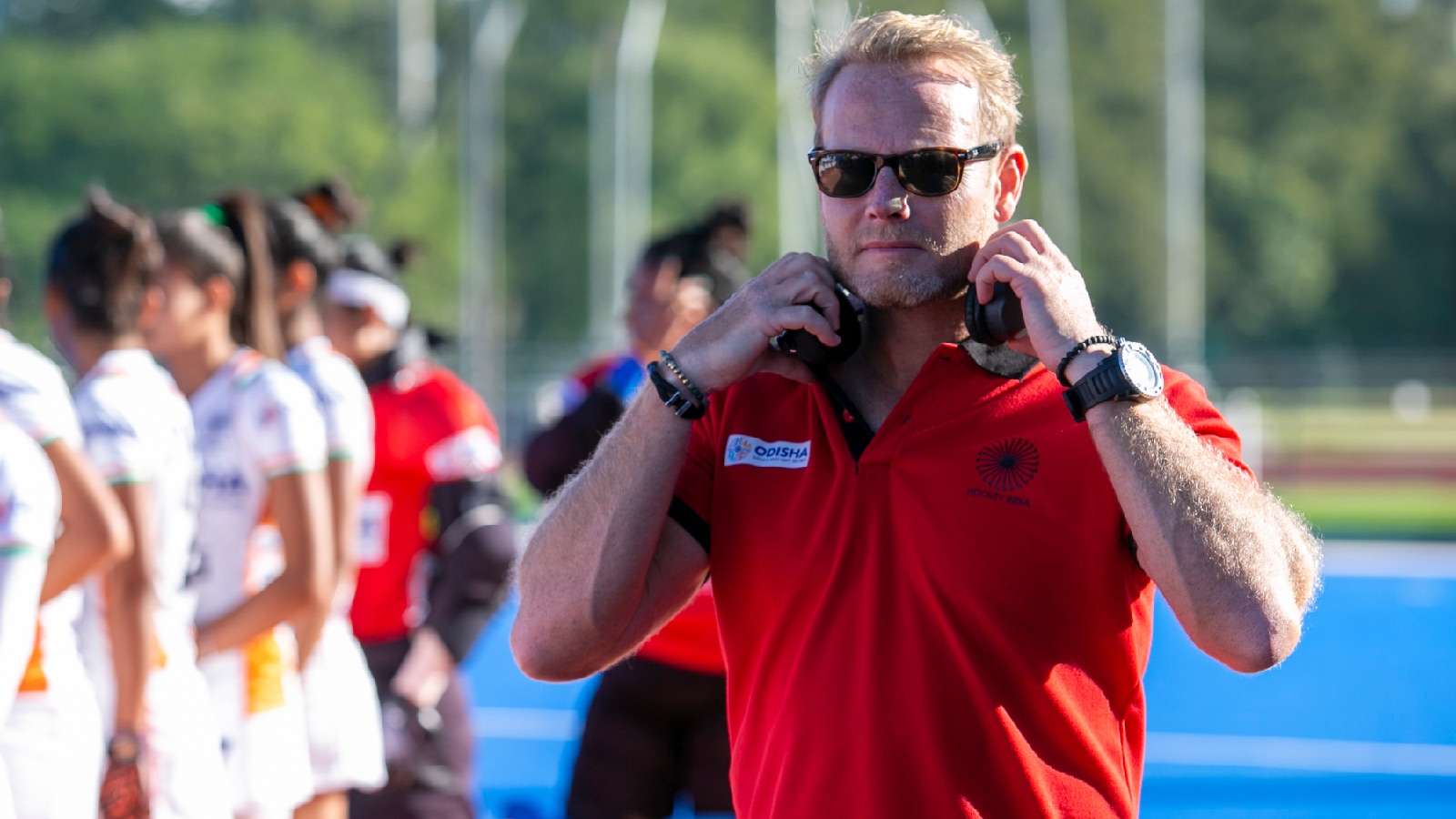


Sjoerd Marijne’s India Blueprint: Inside the training, tactics and mindset shift driving women’s hockey team
Dutch coach lays emphasis on discipline, clarity, speed and demands interdependence as he sets sights on the year’s two biggest tests: World Cup followed by Asian Games
The stories travelled ahead of him.
Long before Sjoerd Marijne gathered the current core of the Indian women’s hockey team, the younger players had already heard whispers. About the grind, the discipline, and most famously, the eight-hour training sessions in the lead-up to the Tokyo Olympics.
So when Marijne now casually asks, “Do you have heavy legs?”, the response is almost rehearsed. “No, no, no, coach.” The sessions may not (yet) be as brutal, but the message has landed. Loud and clear.
The old-timers in the team — the Lalremsiamis, Navneet Kaurs and Sushila Chanus — experienced this after they qualified for the Tokyo Olympics in late 2019. When the players reassembled for the national camp in Bengaluru, Marijne — unhappy with the lethargy shown in the qualifying match — scheduled a one-off eight-hour training session. It started at 8 in the morning and ended at 4 pm, with a short lunch break being the only downtime.
For Marijne, the significance of that marathon session was never about punishment. It was about imprinting a mindset — one that he believes the team is already beginning to absorb without needing to relive the extremes. “The girls understand,” he says, almost with satisfaction.
What he wants now is something deeper, less visible but far more critical: interdependence. “You need each other to perform as an individual. Not the other way around.”
That philosophy is expected to take sharper shape when the squad regroups at the national camp in Bengaluru on March 27. The agenda is clear — reinforce structure, sharpen discipline, and build a style of play that is unmistakably his.
And that style? Fast. Direct. Relentless.
Marijne speaks with certainty when he says he ‘knows exactly’ how he wants India to play. The early glimpses, he believes, are already visible. “There’s more clarity. More structure. Discipline is higher. And they feel more free.”
The recent FIH Hockey Olympic Qualifiers offered the first real test of that evolving identity. There were encouraging signs — particularly the commitment to a high-tempo game and improved defensive cohesion. But there were also reminders of how fragile progress can be.
Take the match against Italy. On paper, a win. In reality, a warning. “It was our weakest game of the tournament,” Marijne admits. India had lost such matches in the past. This time, they didn’t. That, he concedes, is progress.
But the performance exposed fault lines — pressure-induced errors, disrupted rhythm, and an inability to impose their speed against a compact, low-block opposition.
“You make technical errors, you cannot come into the flow; you cannot play with rhythm.”
The semi-final brought a different kind of learning. The weight of expectations revealed who could hold their level — and who couldn’t.
Then came England in the final. A game where, by Marijne’s reading, the numbers told a story of promise rather than defeat. India created chances, earned penalty corners, and limited clear opportunities — yet still fell short.
For him, that gap is both frustrating and encouraging. “You cannot train a hundred things. You have to choose what is important.”
Heading into the qualifiers — Marijne had a little more than a month to prepare for it —- the priority had been clarity, unity, and defensive discipline. Next comes the obvious — and often the hardest — step: finishing.
The next phase won’t just be tactical. It will be deeply personal.
Marijne plans one-on-one conversations with players, dissecting moments from high-pressure games — the semi-finals, the final — not just to correct decisions, but to understand thought processes. “The better I understand them as a person, the better I understand their choices on the pitch,” he says.
It’s a coach trying to map the mental terrain as much as the physical one. Because physically, there is still ground to cover. The squad entered the qualifiers on the back of multiple injuries. By the start of the tournament, most had returned, but were far from peak fitness. “You can’t do that in six weeks,” the Dutchman adds.
The upcoming tours to Argentina and the United States will double as both competition and conditioning. The demand: play, recover, improve, repeat.
Hovering over everything is the larger target — the Asian Games. For Marijne, the year revolves around it. Not just for the medal, but for what it unlocks: direct qualification to the 2028 Los Angeles Olympics. The World Cup, in that sense, becomes both a proving ground and a preparation tool.
He’s seen this script before. Back in 2018, a strong World Cup showing fed into an Asian Games silver medal run. He believes history can repeat itself. “I think we can play two big tournaments.”
There’s also a personal layer. The World Cup will be held in his home country, the Netherlands. “I know how good they can organise these things. And I know how amazing an event it will be. And that’s why personally for me, I really like to go there and I’m really happy we qualified for this,” Marijne says.
Beyond that awaits the familiar challenge — a continental rival in China, likely standing between India and Olympic qualification, given that the Paris Olympics silver medallists will be the team to beat for the Asian Games gold and the resultant LA 2028 berth.
But Marijne isn’t looking that far just yet. For now, the focus is simpler. Harder, too.
Build the team. Sharpen the system. Strengthen the mind.
The stories travelled ahead of him.
Long before Sjoerd Marijne gathered the current core of the Indian women’s hockey team, the younger players had already heard whispers. About the grind, the discipline, and most famously, the eight-hour training sessions in the lead-up to the Tokyo Olympics.
So when Marijne now casually asks, “Do you have heavy legs?”, the response is almost rehearsed. “No, no, no, coach.” The sessions may not (yet) be as brutal, but the message has landed. Loud and clear.
The old-timers in the team — the Lalremsiamis, Navneet Kaurs and Sushila Chanus — experienced this after they qualified for the Tokyo Olympics in late 2019. When the players reassembled for the national camp in Bengaluru, Marijne — unhappy with the lethargy shown in the qualifying match — scheduled a one-off eight-hour training session. It started at 8 in the morning and ended at 4 pm, with a short lunch break being the only downtime.
For Marijne, the significance of that marathon session was never about punishment. It was about imprinting a mindset — one that he believes the team is already beginning to absorb without needing to relive the extremes. “The girls understand,” he says, almost with satisfaction.
What he wants now is something deeper, less visible but far more critical: interdependence. “You need each other to perform as an individual. Not the other way around.”
That philosophy is expected to take sharper shape when the squad regroups at the national camp in Bengaluru on March 27. The agenda is clear — reinforce structure, sharpen discipline, and build a style of play that is unmistakably his.
And that style? Fast. Direct. Relentless.
Marijne speaks with certainty when he says he ‘knows exactly’ how he wants India to play. The early glimpses, he believes, are already visible. “There’s more clarity. More structure. Discipline is higher. And they feel more free.”
The recent FIH Hockey Olympic Qualifiers offered the first real test of that evolving identity. There were encouraging signs — particularly the commitment to a high-tempo game and improved defensive cohesion. But there were also reminders of how fragile progress can be.
Take the match against Italy. On paper, a win. In reality, a warning. “It was our weakest game of the tournament,” Marijne admits. India had lost such matches in the past. This time, they didn’t. That, he concedes, is progress.
But the performance exposed fault lines — pressure-induced errors, disrupted rhythm, and an inability to impose their speed against a compact, low-block opposition.
“You make technical errors, you cannot come into the flow; you cannot play with rhythm.”
The semi-final brought a different kind of learning. The weight of expectations revealed who could hold their level — and who couldn’t.
Then came England in the final. A game where, by Marijne’s reading, the numbers told a story of promise rather than defeat. India created chances, earned penalty corners, and limited clear opportunities — yet still fell short.
For him, that gap is both frustrating and encouraging. “You cannot train a hundred things. You have to choose what is important.”
Heading into the qualifiers — Marijne had a little more than a month to prepare for it —- the priority had been clarity, unity, and defensive discipline. Next comes the obvious — and often the hardest — step: finishing.
The next phase won’t just be tactical. It will be deeply personal.
Marijne plans one-on-one conversations with players, dissecting moments from high-pressure games — the semi-finals, the final — not just to correct decisions, but to understand thought processes. “The better I understand them as a person, the better I understand their choices on the pitch,” he says.
It’s a coach trying to map the mental terrain as much as the physical one. Because physically, there is still ground to cover. The squad entered the qualifiers on the back of multiple injuries. By the start of the tournament, most had returned, but were far from peak fitness. “You can’t do that in six weeks,” the Dutchman adds.
The upcoming tours to Argentina and the United States will double as both competition and conditioning. The demand: play, recover, improve, repeat.
Hovering over everything is the larger target — the Asian Games. For Marijne, the year revolves around it. Not just for the medal, but for what it unlocks: direct qualification to the 2028 Los Angeles Olympics. The World Cup, in that sense, becomes both a proving ground and a preparation tool.
He’s seen this script before. Back in 2018, a strong World Cup showing fed into an Asian Games silver medal run. He believes history can repeat itself. “I think we can play two big tournaments.”
There’s also a personal layer. The World Cup will be held in his home country, the Netherlands. “I know how good they can organise these things. And I know how amazing an event it will be. And that’s why personally for me, I really like to go there and I’m really happy we qualified for this,” Marijne says.
Beyond that awaits the familiar challenge — a continental rival in China, likely standing between India and Olympic qualification, given that the Paris Olympics silver medallists will be the team to beat for the Asian Games gold and the resultant LA 2028 berth.
But Marijne isn’t looking that far just yet. For now, the focus is simpler. Harder, too.
Build the team. Sharpen the system. Strengthen the mind.