

How Vidit Gujrathi built the AI brain behind World Championship broadcast
The GM spent sleepless nights to create the central feature of the title match's official broadcast
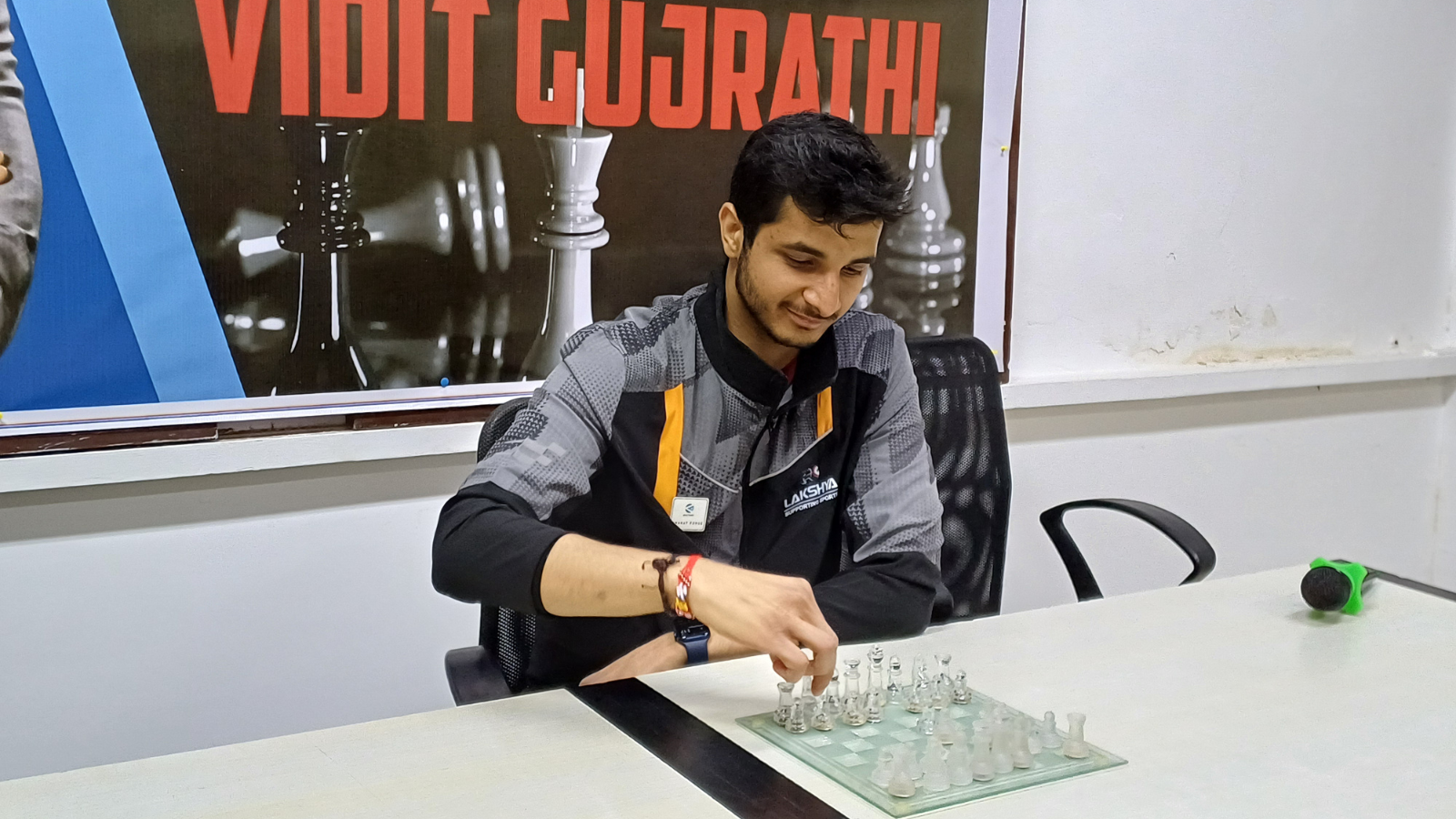
For weeks leading up to the 2026 World Chess Championship in Geneva, Indian Grandmaster Vidit Gujrathi was running on three hours of sleep after a string of sleepless nights. It was not because he was burning the midnight oil, secretly working as a second for D Gukesh or Javokhir Sindarov, rushing to finalise an opening line at the eleventh hour. Instead, the 32-year-old was racing against the clock on an AI passion project that had unexpectedly become a central feature of the title match’s official broadcast.
Teaming up with FIDE just weeks before the title match, Vidit has helped reshape how fans experience chess’s biggest stage by making the championship live stream sharper, smarter and far more engaging.
Vidit has helped FIDE build their proprietary human-move prediction AI tool, which solves a long-standing problem for anyone watching a chess broadcast. Traditional chess computers, known as engines, are superhuman calculators that spit out the objectively best move on the board. For casual viewers, that often makes top players look baffling when they choose a safer, practical move over an ultra-complex computer line. Vidit’s model changes that approach by analysing vast databases of past games to predict, which move a human Grandmaster is most likely to play next, paired with real-time broadcast stats.
The idea began almost casually when Vidit was eyeing a hackathon prize. “Once I wanted to participate in a hackathon and the prize was $10,000 and an NVIDIA DGX Spark, a computer where you can run local AI models,” he recalls to The Indian Express.
Chess engines tell you the best move.
But grandmasters are human, they don’t always play it.
So I built “Kibitz”: a human move predictor for chess broadcasts. I trained this model on my Nvidia RTX 5080.
Then I made it run as a business by itself.
A channel buys the overlay, Hermes onboards them, charges via @stripe test mode, runs the broadcast, narrates with @NVIDIAAI Nemotron, tracks inference cost, and books its own P&L.
I build. Hermes operates.
This is my demo and entry for the @NousResearch × @NVIDIAAI × @stripe Hermes Agent Accelerated Business Hackathon.
— Vidit Gujrathi (@viditchess) June 29, 2026
“I thought, let’s create something useful and interesting. That’s when I thought we should build AI models that can predict what a human will play rather than just having engines lying around. Who knew that today it would be so mainstream and we would use it in the World Championship match, at the highest level?” he says.
Beyond the move predictor, the innovation team has focused on solving classical chess’s biggest broadcast hurdle: long stretches of silence while players spend 15 to 20 minutes calculating a single move. Alongside Grandmaster commentators Peter Leko and Peter Svidler, the stream now feeds viewers live statistical dashboards, real-time insights into how players manage their clocks and positions, and instant social media recaps and short video clips pushed out mid-game to hook casual fans scrolling online.
For FIDE CEO Emil Sutovsky, bringing Vidit on board was more than just a one-off experiment. Having spotted Vidit’s experiments on social media and his personal website, Sutovsky reached out barely a month before the championship to bring him into a dedicated five-member team that also includes Israeli Grandmaster Alik Gershon.
“It is not a one-off project which we commissioned him for. It is ongoing, and he will work with us for at least the next half a year on various integrations of AI, modeling, and Grandmaster insight,” Sutovsky tells The Indian Express in Geneva.
“One big problem with AI is that it cannot be blindly trusted, particularly on sensitive matters like how a human Grandmaster thinks. You need a top player in the room. When I spoke to Vidit, it was clear he has not only the technical ability and chess understanding, but a vision aligned with ours,” he adds.
That partnership triggered a two-week sprint to get the predictor model and live statistical insights ready in time for Geneva. “We realised we had less than two weeks before the World Championship. We hadn’t planned to implement it there, but we thought, let’s take a risk. In two weeks we got a lot of work done, and I was having sleepless nights, to be honest. Even right now as I speak, I slept only three hours last night,” recounts Vidit.
Never been this nervous before a match I’m not even playing 😂
A lot of love & tokens went into this haha.
We’re taking a very small step to improve broadcast & how chess is perceived. Many more things to come.
Thank you @EmilSutovsky and the @FIDE_chess team for being open to experimenting and having ambitious goals!
Excited to watch the commentary from 7.15pm IST and the games!
— Vidit Gujrathi (@viditchess) November 24, 2026
Sutovsky, meanwhile, sees the Geneva rollout as an early prototype for a commercial broadcast product FIDE aims to pitch to major networks and streaming platforms by the second quarter of 2027, with faster-paced versions already being tested in time for next month’s World Rapid and Blitz Championships in Istanbul.
“Here in classical chess, you have the luxury when a player thinks for five or 15 minutes. You need different activations in faster time controls, and we will be ready to present those to the public next month,” Sutovsky explains.
For Vidit, a former FIDE Grand Swiss winner and 2024 Chess Olympiad gold medallist, building tools has become a fresh outlet after stepping back from a full-time tournament grind. Now describing himself as a “semi-professional” player who will still compete in select events, he is channelling his energy into making chess more accessible to viewers.
“When people are watching the game, they should feel engaged, entertained, and feel the joy and passion for chess that we feel. I want to convey that and get people more into the game of chess as I believe it’s a beautiful game,” he says.