

The men, the machines (and the psychic mediums) that helped top grandmasters prepare for elite tournaments
From glass-eating hypnotists to yoga gurus to $1 million supercomputers, the bizarre evolution of how Grandmasters strive to win.
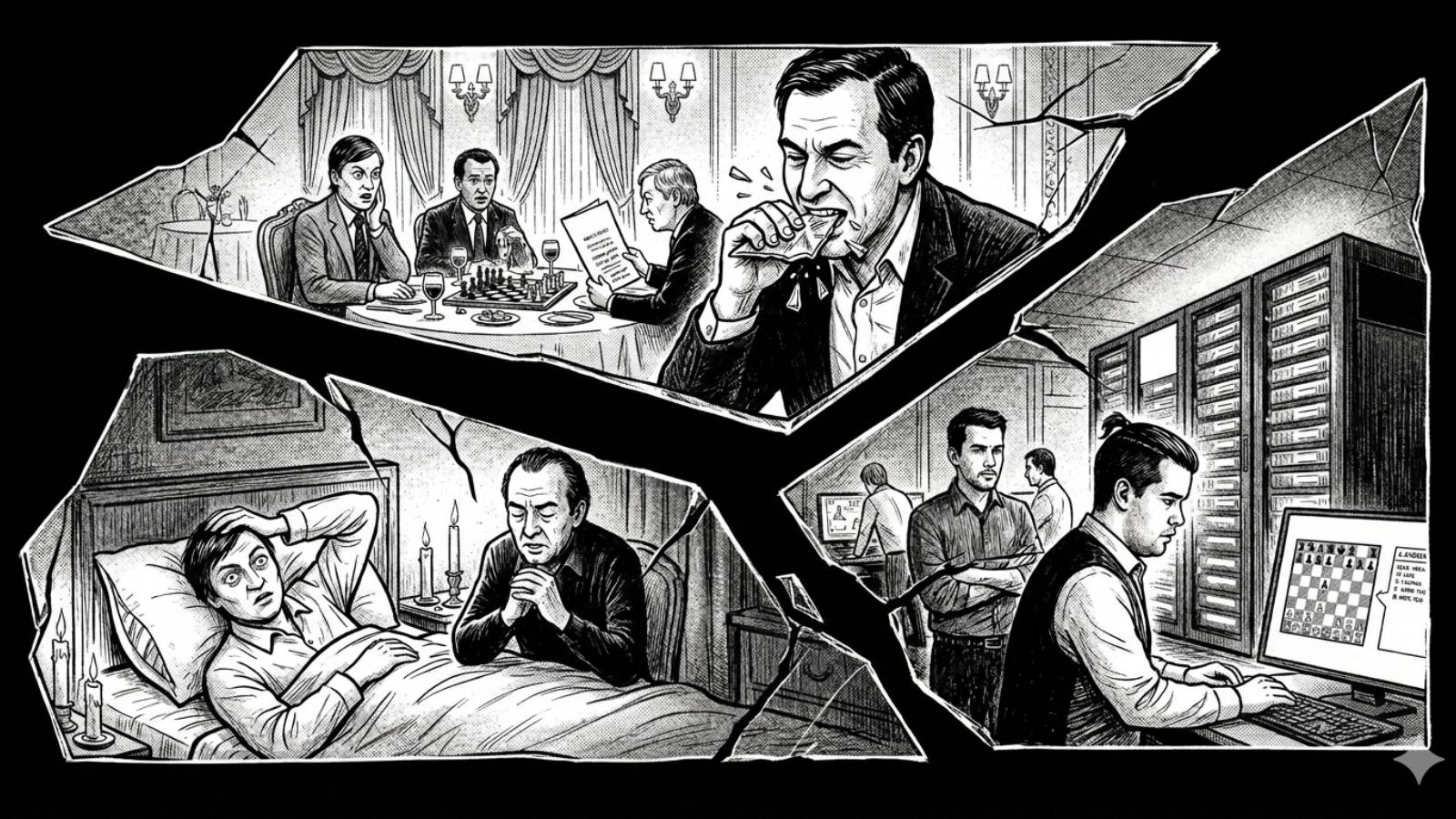
Anatoly Karpov remembers the night one of his aides, Grisha Rozhkovsky, started to eat a broken piece of glass during dinner.
It sounds like an urban legend concocted by some nameless KGB agent to try and spook an adversary. But Karpov, the 12th world champion in chess history, swears it happened (in an interview given to Russia’s Sport Express back in 2015).
The story goes that Karpov and his team were having a meal together, still trying to digest a tough loss to the upstart Garry Kasparov in the 1985 World Chess Championship, when Rozhkovsky, who was a hypnotist from Odessa, decided the team could do with a bit of cheering up. So he pulled out a piece of glass, and started crunching on it.
Rozhkovsky was not the only hypnotist helping the world’s best chess players back in those days. At that same battle, after Kasparov had sunk to a 0-4 deficit, his team had sent out an SOS to a psychic medium (someone who could communicate with souls of dead people) from Azerbaijan, Tofik Dadashev, who rushed to Moscow to be at Kasparov’s side. Karpov, in an interview decades later, said that Dadashev had managed to “penetrate” his nervous system and destroyed his concentration in one game.
ALSO READ | FIDE’s Candidates gambit in Cyprus comes with a deja vu from the COVID era
Karpov was also known to employ men with similar backgrounds. Responding to his opponent Viktor Korchnoi hiring a parapsychologist (someone who investigates psychic or paranormal phenomenon) for their Candidates Final match at Moscow in 1974, Karpov also brought one of his own parapsychologists, Vladimir Suchar, who worked for the Center for Space Medicine and was known to be a specialist in sleep. But Suchar proved to be a dud. When Karpov struggled to sleep after a particularly stressful game, Suchar sat next to his bed for two nights muttering things under his breath unsuccessfully trying to lull Karpov to sleep. But Karpov remained wide awake. It’s no surprise that psychic mediums and parapsychologists soon went out of fashion.
A measure of how deeply Korchnoi wanted to beat Karpov in the 1978 World Championship in Baguio was that he hired two gurus from a sect called Ananda Marga. There were rumours that the duo was out on bail while contesting charges of murder. To make matters more interesting, the Baguio police arrested three people close to the event who threatened to use black magic to make Korchnoi lose unless he coughed up $15,000.
When the Candidates chess tournament begins in Cyprus on March 28, it is unlikely that hypnotists with an appetite for glass or parapsychologists who mumble you to sleep will be helping any of the 16 contenders. These days, when a top grandmaster is putting together a team to help them prepare for an assault on the Candidates or the World Championship, the personnel they pick tend to be those who can help them perform on the chess board, rather than trying to mess with the brainwaves of their opponents.
Usually, this means packing a team with ‘seconds’—grandmasters who act as aides and whose job is to help a contender with opening prep ideas or act as a sparring partner to get them match ready. Depending on the budget, a modern team can have as many as five seconds, each assigned specific tasks.
For example, when Gukesh put together his team for the world championship in 2024, he had six grandmasters (Grzegorz Gajewski, Radoslaw Wojtaszek, Pentala Harikrishna, Vincent Keymer, Jan-Krzysztof Duda and Jan Klimkowski) helping him. Of these, only Keymer was not part of his team for the Candidates. Each member of the side had a role assigned. Duda, in particular, was brought on board to play sparring games to sharpen Gukesh’s play in the faster time controls. Another addition to Team Gukesh had been mind guru Paddy Upton, who worked with the teen for six months leading to the World Championship.
In contrast to Gukesh, when Russia’s Sergey Karjakin assembled his team for the 2016 Candidates, besides four seconds, his team also had a massage therapist to help his muscles relax after the tough grind of competitive chess games. Reportedly, when he played in the World Championship later that year, Karjakin’s team also had a physio and a cook. Karjakin’s manager Kirill Zangalis even told Russian newspaper Sport Express that they had spent over a million dollars to train for the World Championship contest in 2016.
Of course with modern chess players guarding the identities of their team members more zealously than poker players hide their cards, little is known about who is helping out which player at the upcoming Candidates. What we do know is that anonymity comes at a premium.
Kazakh grandmaster Bibisara Assaubayeva, who is heading to Cyprus to play in her first Candidates tournament, has a 11-member team backing her. Assaubayeva told Tengri TV in an interview recently that she pays her personal coach 60,000 euros a year (approximately Rs 65 lakh).
“He charges 1000 euros per day (approximately Rs one lakh). And I need to hold at least six training camps with him, usually lasting 10 days a year. And all of this is not counting air tickets, food and other expenses during training camps,” she said. “After making the cut for the Candidates, I needed much more complex preparation. My team of 11 people includes sparring partners, and coaches for opening, middle coaches, and endgame phases. You can’t have just one opening coach, because they cannot handle the volume of information,” Bibisara said.
Occasionally the secret weapon helping a chess player with his prep will not be human. When Ian Nepomniachtchi won the 2021 Candidates tournament, helping him was a supercomputer called Zhores. Based in Moscow’s Skolkovo Institute of Science and Technology, Zhores helped Nepo and his team evaluate tens of millions of positions per second.
A decade before this, Veselin Topalov also got help from one of the most powerful supercomputers in the world: Blue Gene / P of IBM. The computer, running on 8792 processors and using the latest Rybka program, was a loan to Topalov from the Bulgarian ministry of defence. He also had help from a team of experts, who created a special chess program so Topalov could interact with the supercomputer. It was only because Anand had help from three world champions—Garry Kasparov, Vladimir Kramnik and Magnus Carlsen—that he was able to overcome Topalov’s obvious edge in the openings in that World Championship.
Parapsychologists and psychic mediums muttering under their breath are a thing of the past. Players don’t need supercomputers on loan from the government either. The winner of the Candidates in Cyprus might just be the player with the sharpest team of seconds working for them in the engine room behind the scenes.
Anatoly Karpov remembers the night one of his aides, Grisha Rozhkovsky, started to eat a broken piece of glass during dinner.
It sounds like an urban legend concocted by some nameless KGB agent to try and spook an adversary. But Karpov, the 12th world champion in chess history, swears it happened (in an interview given to Russia’s Sport Express back in 2015).
The story goes that Karpov and his team were having a meal together, still trying to digest a tough loss to the upstart Garry Kasparov in the 1985 World Chess Championship, when Rozhkovsky, who was a hypnotist from Odessa, decided the team could do with a bit of cheering up. So he pulled out a piece of glass, and started crunching on it.
Rozhkovsky was not the only hypnotist helping the world’s best chess players back in those days. At that same battle, after Kasparov had sunk to a 0-4 deficit, his team had sent out an SOS to a psychic medium (someone who could communicate with souls of dead people) from Azerbaijan, Tofik Dadashev, who rushed to Moscow to be at Kasparov’s side. Karpov, in an interview decades later, said that Dadashev had managed to “penetrate” his nervous system and destroyed his concentration in one game.
ALSO READ | FIDE’s Candidates gambit in Cyprus comes with a deja vu from the COVID era
Karpov was also known to employ men with similar backgrounds. Responding to his opponent Viktor Korchnoi hiring a parapsychologist (someone who investigates psychic or paranormal phenomenon) for their Candidates Final match at Moscow in 1974, Karpov also brought one of his own parapsychologists, Vladimir Suchar, who worked for the Center for Space Medicine and was known to be a specialist in sleep. But Suchar proved to be a dud. When Karpov struggled to sleep after a particularly stressful game, Suchar sat next to his bed for two nights muttering things under his breath unsuccessfully trying to lull Karpov to sleep. But Karpov remained wide awake. It’s no surprise that psychic mediums and parapsychologists soon went out of fashion.
A measure of how deeply Korchnoi wanted to beat Karpov in the 1978 World Championship in Baguio was that he hired two gurus from a sect called Ananda Marga. There were rumours that the duo was out on bail while contesting charges of murder. To make matters more interesting, the Baguio police arrested three people close to the event who threatened to use black magic to make Korchnoi lose unless he coughed up $15,000.
When the Candidates chess tournament begins in Cyprus on March 28, it is unlikely that hypnotists with an appetite for glass or parapsychologists who mumble you to sleep will be helping any of the 16 contenders. These days, when a top grandmaster is putting together a team to help them prepare for an assault on the Candidates or the World Championship, the personnel they pick tend to be those who can help them perform on the chess board, rather than trying to mess with the brainwaves of their opponents.
Usually, this means packing a team with ‘seconds’—grandmasters who act as aides and whose job is to help a contender with opening prep ideas or act as a sparring partner to get them match ready. Depending on the budget, a modern team can have as many as five seconds, each assigned specific tasks.
For example, when Gukesh put together his team for the world championship in 2024, he had six grandmasters (Grzegorz Gajewski, Radoslaw Wojtaszek, Pentala Harikrishna, Vincent Keymer, Jan-Krzysztof Duda and Jan Klimkowski) helping him. Of these, only Keymer was not part of his team for the Candidates. Each member of the side had a role assigned. Duda, in particular, was brought on board to play sparring games to sharpen Gukesh’s play in the faster time controls. Another addition to Team Gukesh had been mind guru Paddy Upton, who worked with the teen for six months leading to the World Championship.
In contrast to Gukesh, when Russia’s Sergey Karjakin assembled his team for the 2016 Candidates, besides four seconds, his team also had a massage therapist to help his muscles relax after the tough grind of competitive chess games. Reportedly, when he played in the World Championship later that year, Karjakin’s team also had a physio and a cook. Karjakin’s manager Kirill Zangalis even told Russian newspaper Sport Express that they had spent over a million dollars to train for the World Championship contest in 2016.
Of course with modern chess players guarding the identities of their team members more zealously than poker players hide their cards, little is known about who is helping out which player at the upcoming Candidates. What we do know is that anonymity comes at a premium.
Kazakh grandmaster Bibisara Assaubayeva, who is heading to Cyprus to play in her first Candidates tournament, has a 11-member team backing her. Assaubayeva told Tengri TV in an interview recently that she pays her personal coach 60,000 euros a year (approximately Rs 65 lakh).
“He charges 1000 euros per day (approximately Rs one lakh). And I need to hold at least six training camps with him, usually lasting 10 days a year. And all of this is not counting air tickets, food and other expenses during training camps,” she said. “After making the cut for the Candidates, I needed much more complex preparation. My team of 11 people includes sparring partners, and coaches for opening, middle coaches, and endgame phases. You can’t have just one opening coach, because they cannot handle the volume of information,” Bibisara said.
Occasionally the secret weapon helping a chess player with his prep will not be human. When Ian Nepomniachtchi won the 2021 Candidates tournament, helping him was a supercomputer called Zhores. Based in Moscow’s Skolkovo Institute of Science and Technology, Zhores helped Nepo and his team evaluate tens of millions of positions per second.
A decade before this, Veselin Topalov also got help from one of the most powerful supercomputers in the world: Blue Gene / P of IBM. The computer, running on 8792 processors and using the latest Rybka program, was a loan to Topalov from the Bulgarian ministry of defence. He also had help from a team of experts, who created a special chess program so Topalov could interact with the supercomputer. It was only because Anand had help from three world champions—Garry Kasparov, Vladimir Kramnik and Magnus Carlsen—that he was able to overcome Topalov’s obvious edge in the openings in that World Championship.
Parapsychologists and psychic mediums muttering under their breath are a thing of the past. Players don’t need supercomputers on loan from the government either. The winner of the Candidates in Cyprus might just be the player with the sharpest team of seconds working for them in the engine room behind the scenes.