

We need a national mission for negotiated justice
Litigants need to understand that entering a plea bargain is not an admission of defeat nor an unfair deal but a wise tactical decision
In his seminal work On Crimes and Punishment, the Italian criminologist Cesare Beccaria wrote, “Crimes are more effectually prevented by the certainty than the severity of punishment… The certainty of a small punishment will be more impressive than the fear of a more terrible one, but moderated by the hope of impunity.” His perspectives on criminal justice remain important to this day. The efficacy of justice systems is not only dependent on punishment, but also on certainty, predictability, and quick resolution of disputes.
More than 5 crore cases are still open in Indian courts, the Centre told Parliament last year. About 4.76 crore are pending in district and subordinate courts, over 63 lakh in high courts, and over 92,000 in the Supreme Court. More than 80 per cent of India’s judicial backlog is in district courts, where the common person interacts most directly with the justice system. The backlog reached record levels during the pandemic and has continued to rise despite reforms, such as the e-Courts project, launched to expand and digitise the judicial system, as well as institutional initiatives like fast-track courts and Lok Adalats.
We need to recognise that this is not an administrative issue, but a structural one.
For victims, long legal battles can mean a second trauma. For pre-trial detainees, delayed trials mean years of imprisonment before they are found guilty or acquitted. For individuals involved in civil disputes, such as property or divorce cases, protracted legal battles can result in substantial financial losses.
Delays are bad for the economy as well. A slow justice system makes it harder to enforce contracts, raises the cost of doing business and dissipates investor confidence. It sends the wrong signal to the investors about the country’s investment climate. A slow judicial process makes the legal system appear weaker to citizens. This, in turn, creates a crisis of legitimacy.
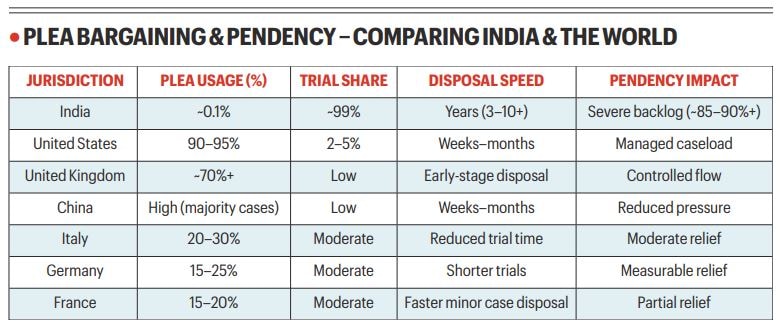
Plea bargaining is a relatively new concept in India’s formal criminal justice system. People traditionally thought that negotiated settlements were less fair or left room for extortion. The 2005 amendment to the Code of Criminal Procedure formally introduced plea bargaining into the Indian criminal justice system. It allowed the accused to take responsibility for the crime on their own terms, usually by agreeing to a deal that includes lower charges or a lighter sentence. When practised in a way that is fair and legal, this can serve the interests of both the state and the accused by allowing the case to proceed more quickly and efficiently.
However, after 20 years, plea bargaining has been adopted in less than one per cent of cases. The effective use of this mechanism remains impeded for several reasons, including procedural hesitation, absence of institutional incentives, and lack of understanding among prosecutors, defence lawyers, and litigants. This is unfortunate because experiences from around the world, including the US, England, Canada and Australia, show that negotiated dispute resolution mechanisms are some of the best ways to deal with large volume of cases. In fact, more than 90 per cent of criminal cases in the US are settled through plea deals instead of full trials.
Plea-bargaining comprises the core of the justice system in several countries, with the understanding that it does not diminish the equity of the justice system. India needs to draw from these global experiences and make them work in our own constitutional and institutional setting.
The country should consider incorporating this practice for at least five good reasons.
One, given the sheer number of pending cases, it would be impossible to deal with them on an individual basis. Neither a judiciary capable of withstanding greater workloads nor improved infrastructure alone will be sufficient to have any effect.
Two, the outcome of a trial can be highly uncertain, costly, and time-consuming. Plea-bargaining presents an alternative to both parties to arrive at a mutual agreement.
Three, negotiated settlements enable the police, prosecutors, and courts to carry out their jobs effectively. It allows them to devote their time and resources to complicated and serious crimes.
Four, victims are happier to settle their cases by plea-bargaining than through a long legal battle. Crimes often disrupt people’s lives. Victims would prefer that cases be resolved quickly with the confession of the guilty.
Five, effective plea bargaining makes the justice system work better as a whole.
In a recent speech, the Attorney General for India, R Venkataramani, observed, “There is a new need for a national protocol for plea bargaining… which can, in a very healthy way, advise, guide and counsel practitioners as well as victims… so that the protocol can work in a more transparent and objective way.”
India must plan to set up a national mission for negotiated justice to make plea bargaining and pre-trial settlement mechanisms more common. This could be called the Sahmati Samadhan Nyaya Mission. There would be a few important parts to such a mission.
Prosecutors must be trained, and institutional readiness must be ensured. Prosecutors need to be able to negotiate fair and open plea deals that protect the public’s interests while ensuring that cases are settled in a reasonable timeframe.
The way lawyers are paid should be reformed. Prosecutors and defence lawyers must have a professional interest in reaching a settlement through negotiations.
Judges should encourage early settlement methods. Courts can exercise judicial discretion in deciding which cases are appropriate for plea-bargaining and can encourage the setting up of structured negotiations before the trials start.
People need to be aware of how the law may be used for their benefit. Litigants need to understand that entering a plea bargain is not an admission of defeat nor an unfair deal but a wise tactical decision.
Strong protections and oversight systems need to be put in place to ensure that plea bargains are treated with the weight and gravity they deserve. Coercion, extortion and exploitation must be removed from the system.
If done right, plea bargaining can be a tool to timely justice. It frees up time for more important business in the courts. The courts can devote time to constitutional issues and serious criminal trials while routine and minor cases are settled quickly.
It’s been almost 300 years since Beccaria made the compelling case that justice systems work best when results are certain, timely and predictable. Plea bargaining gives India a way to do just that, and it is finally time to let it reach its full potential.
The writer is founding vice-chancellor, OP Jindal Global University