

Best of Both Sides: TMC’s implosion shows that India’s new generation is not bound by regionalism
The politics of regional exceptionalism, resonates less with a generation that consumes social media, competes in national examinations, aspires to national opportunities, and identifies with a rising India
The implosion of the Trinamool Congress is the terminal crisis of a syndicate that never functioned like a true political party. The TMC is not collapsing because the BJP outmanoeuvred it. It is collapsing because patronage machines, when stripped of patronage, have nothing left to hold them together. It is imploding because it was always structurally incapable of surviving the loss of power.
There is no incentive for the BJP to engineer the collapse of a party facing the wrath of the people and already in free fall.
The locus of the crisis is entirely internal. Dozens of MPs and MLAs are boycotting their own leader’s meeting. Senior functionaries are accusing Mamata Banerjee of nepotism. They blame Abhishek Banerjee for having destroyed the TMC. None of this requires any outside force. It requires only the removal of the one thing that held them together, power.
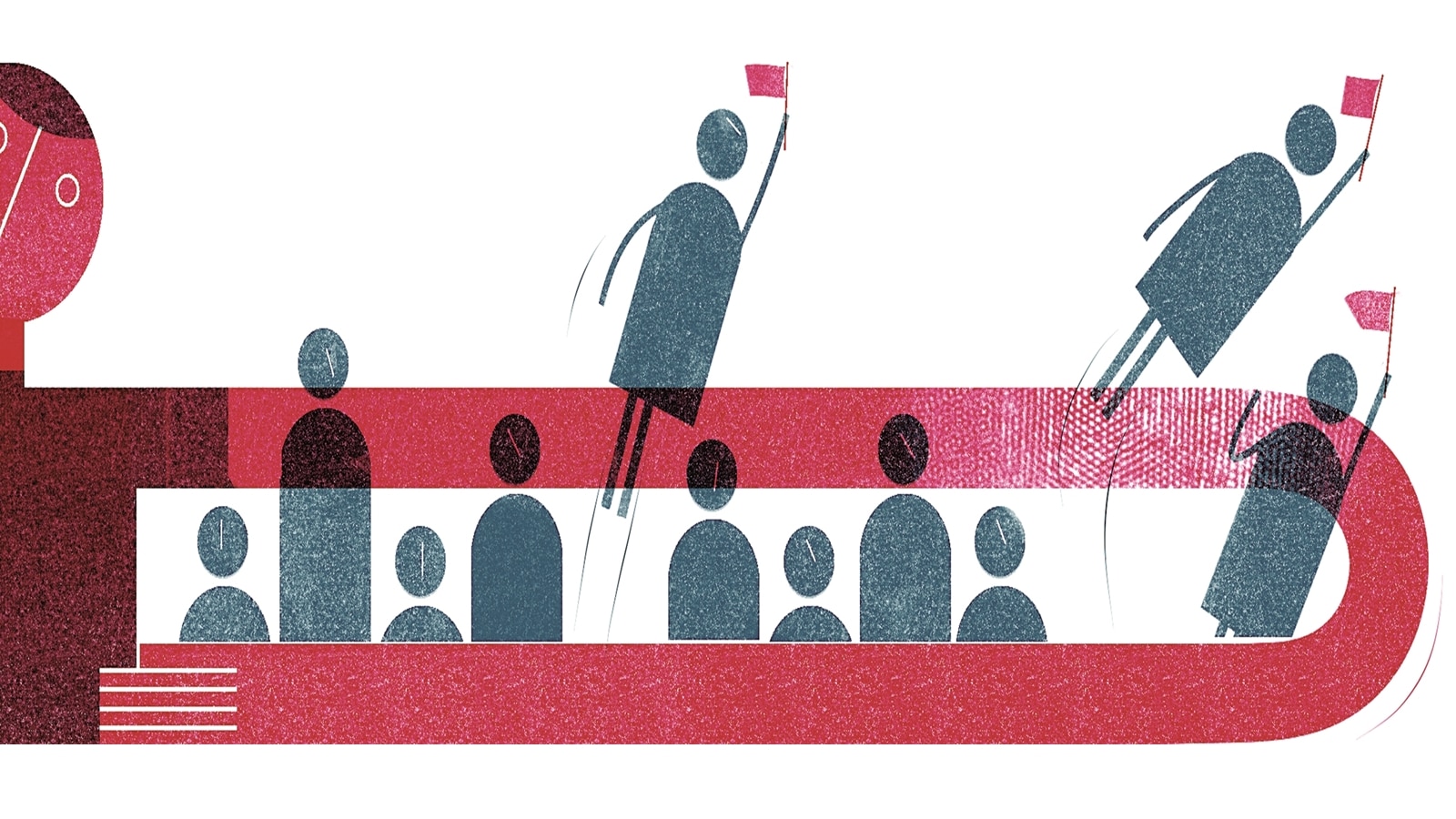
This is the structural weakness of a particular kind of political formation that India has produced in abundance since the 1960s. Such parties lack intra-party democracy and internal accountability. Their origin lies in regional feudalism, often relying on one or two social groups rather than a cadre mobilised around an ideology or vision. They are what can be called “the party of leaders” as opposed to “the party of cadre”, with local strongmen coming together as an interest group, depending on the personal relationship with the leader. When the founding leader weakens, the party does not survive as an institution.
Regional parties of the TMC variety did not emerge from ideological ferment. They emerged from anti-incumbency, a leader who broke with the ruling establishment or national party, mobilised a coalition of resentment, and rode it to power. When in power, the TMC built syndicates, cut-money networks, and an apparatus of violence. The TMC never had any party organisation but a system of coercive patronage. The TMC is, and always was, a franchise arrangement organised around a single leader and the access to state resources that leader could guarantee.
The TMC made an additional, fatal miscalculation, the attempt to hand the succession to a nephew lacking popular legitimacy. Nepotism was compounded by a non-political professional class of consultants, data managers, and campaign designers inserted between the party’s founding leader and its grassroots workers.
The workers in the towns and village booths found themselves lectured on strategy by executives who had never fought a single booth-level battle. It hollowed out whatever remained of organic loyalty to the TMC, replacing it with material expectations. Withdraw the material expectation, and you are left with nothing.
The TMC’s crisis also raises a deeper question about the purpose and lifespan of India’s regional parties. These formations arose at a specific historical moment, following the fracturing of Congress hegemony after 1967, the assertion of caste identities seeking political expression, and the primacy of hyper-local issues that national parties were then structurally ill-equipped to articulate. The TMC itself emerged from a specific anti-incumbency against the Left.
But India’s new generation is not bound by regionalism in its imagination, aspirations, and scale. The politics of regional exceptionalism, the idea that states’ interests are somewhat incompatible with the national interest, resonates less with a generation that consumes social media, competes in national examinations, aspires to national opportunities, and identifies with a rising India far more than with any subnational pride. The TMC’s brand of sub-nationalism was always thin, borrowed from the Left’s exhausted language, never rooted in civilisational depth. A party without ideology, without cadre, without a second tier of leadership, and without a coherent answer to why it should exist as a distinct political formation when faced with a nationally rooted, locally anchored party like the BJP was always one electoral defeat away from implosion.
The TMC was a holding company for individual ambitions. And when the holding company goes bankrupt, individual ambitions find other vehicles. The leaders leaving the TMC today are not traitors. They are merely doing what the TMC always trained them to do. The party built them that way. It has no right to be surprised. What is collapsing is not merely a party but a model of politics that was transactional, violent, nepotistic, and ideologically hollow. And now it has been decisively rejected by the people of Bengal. The obituary of the TMC is being written not in the strategy rooms of the BJP, but in the internal logic of what the TMC always was.
The writer is national vice-president, BJP Youth Wing