

Raghu Rai, the man who saw the world
His images made the viewer aware about the fragile bonds that held the world together. He gave dignity to the individuals he caught on camera, inviting viewers to discover for themselves their emotional truth
Written by Ina Puri
“One should not develop a taste for mourning, and yet mourn we must.”- The Taste of Tears, Jacques Derrida.
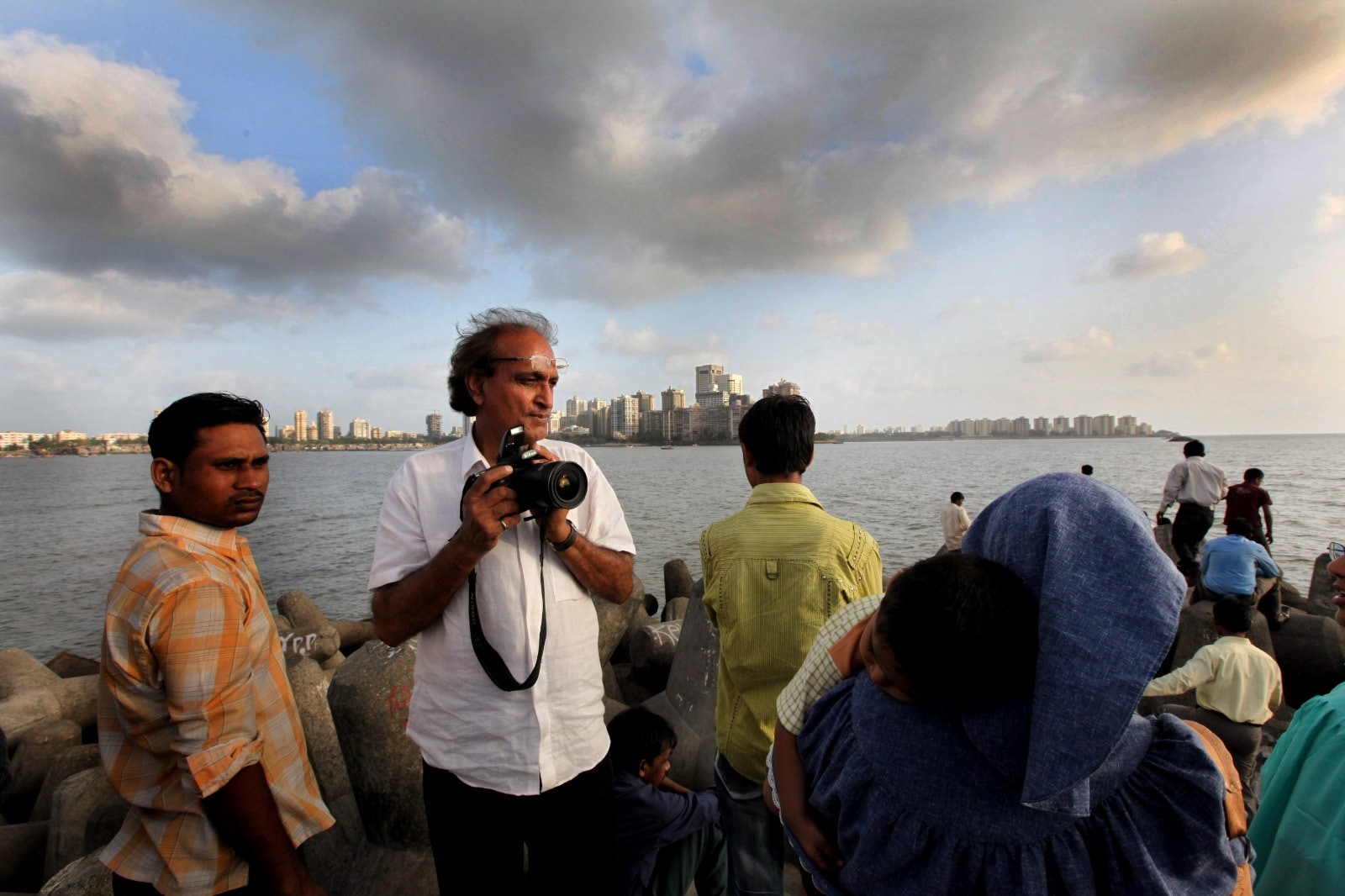
In the midst of classic black-and-white portraits paying homage to the legendary Raghu Rai, my own pictures of the man, taken down the years, are in colour and capture a side of his that is very different, in moments that are unguarded and informal.
I have had the privilege of working with the veteran lensman on some landmark exhibitions and books. This morning, as I go through my personal archives, I see Raghu with his friends Himmat Shah, with Shahidul Alam at the opening of Chobi Mela, Dhaka, when we had travelled together to attend the programme after Shahidul’s release from prison (Rai had been one of the strongest voices from international media to protest against Alam’s illegal incarceration).
There are other photographs too with artist friends, musicians and family. He was a great raconteur. Within moments of meeting to discuss the project we happened to be working on, he would share stories of his years at the desk in The Statesman or India Today, getting access to the top echelons of power, including Indira Gandhi, when she was spending time with her grandchildren. As he would remark, “Whether it was a human-interest story or one of human devastation like the Bhopal gas tragedy, I was there with my camera, ready to document history as I saw it unfold around me.”
There was, in this remark, something that spoke of the breadth of his practice. He had an acute understanding of the fact that the camera was as much a way of inhabiting the world as it was a tool. Rai’s archive is a constellation, ordered by category maybe, but shaped certainly by encounter. To be alongside him while he worked was to see urgency and patience, direction and receptivity, joy and depth moulded into one. He allowed situations to take shape before him, without urgency or insistence. At times, he stepped back, allowing the image to settle into its own form. His photographs carry this quality of arrival, shaped by proximity to history, held steady by an unwavering regard for the human presence within it.
While working with him on his books Calcutta/Kolkata (2008) and Being with Dadu: Satyajit Ray (2021), Rai would speak eloquently of his deep love for the city. I witnessed the affection with which the people of Kolkata loved him back when we were putting together an exhibition at Harrington Street Art Centre in the early 2000s. Even before the works were displayed, his admirers came streaming in, to see his photographs and meet the legend who had, for so long, championed the city and its people. These frames held the ordinary multitudes going about their lives as well as the men and women who stood out for their passion, talent and dedication, people such as Mother Teresa or Satyajit Ray, with both of whom he shared a special bond.
Rai rarely tried to stage frames, capturing vignettes as they were. His images made the viewer aware about the fragile bonds that held the world together. He gave dignity to the individuals he caught on camera, inviting viewers to discover for themselves their emotional truth.
A few years ago, I had the rare privilege of accompanying Raghu with a few other friends to Varanasi, where he was to shoot the Dussehra festivities. My plan had been to decide on an atmospheric haveli to exhibit his works in the ancient city. We had even arrived at a tentative name for the exhibition. Sadly, the pandemic scuttled our plans. My disappointment perhaps had been palpable. A couple of months later, I received a handsome publication from Rai’s office. It was titled Banaras and in its pages, along with the many frames we had deliberated on for the exhibition, was a photograph of mine, in front of the haveli we were to use for our venue. That was Raghu, always attentive to those around him, quintessentially a man who never stopped pulling out a Queen from his pack.
The writer is a curator, documentarian and collector