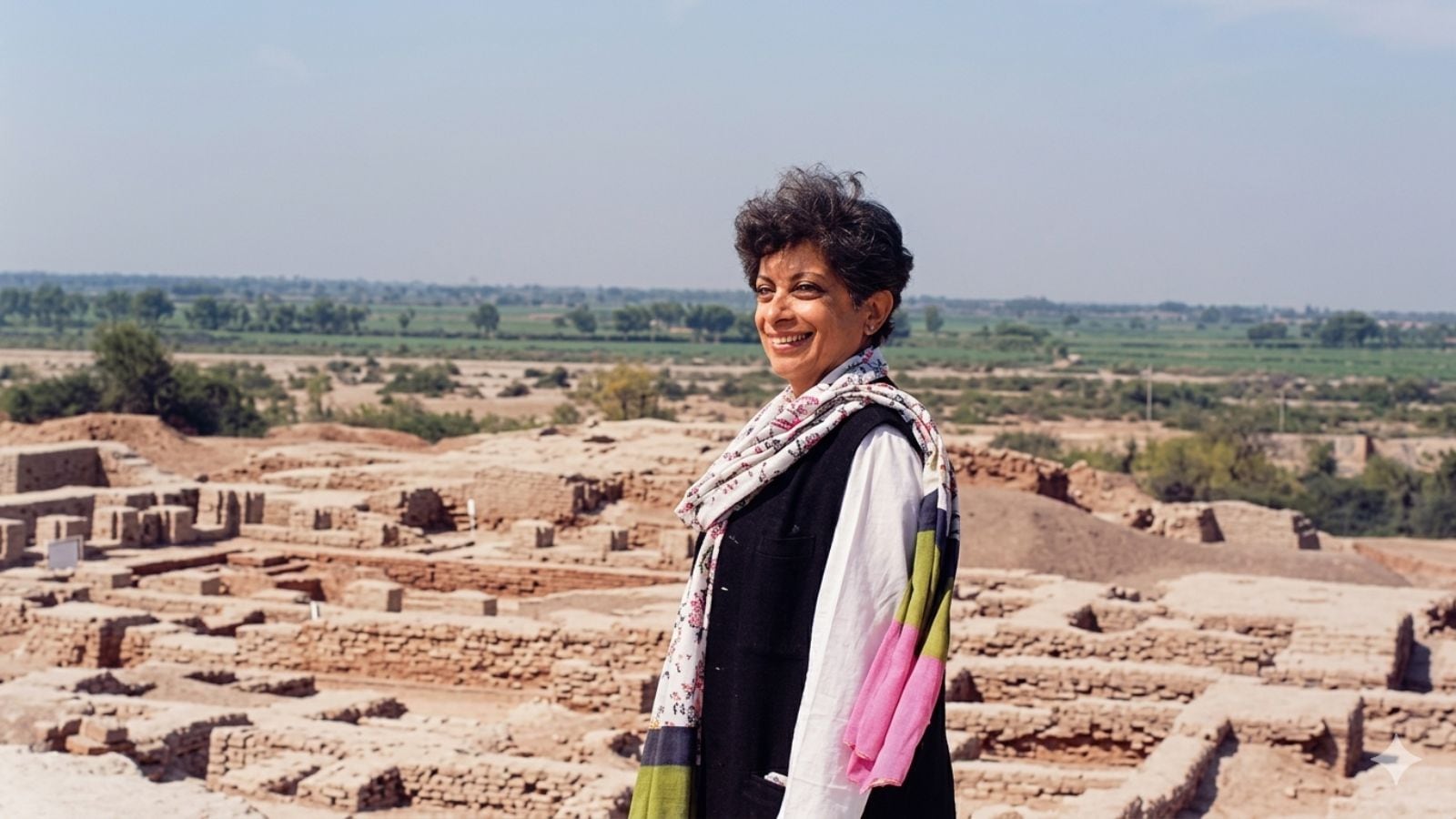


Interpreting Harappa, the Shereen Ratnagar way
Shereen Ratnagar's uncompromising courage was apparent in her intervention in the Babri Masjid dispute
Shereen Ratnagar, who passed away recently, was known for her research centred on the Harappan civilisation. It is not surprising that she chose to work on the trading encounters between West Asia and the Indian Subcontinent in the third millennium BCE, given her training in Archaeology at Deccan College, Pune and the Institute of Archaeology, London, where she specialised in Mesopotamian archaeology. This became the object of her doctoral research at JNU. The book that emanated from her research (Encounters: The Westerly Trade of the Harappa Civilisation) was not a mere detailing of goods and objects that were moved between the Harappan region and areas to the west such as Mesopotamia, Bahrain and Oman; rather, the book, and particularly its second edition (Trading Encounters: From the Euphrates to the Indus in the Bronze Age), provided a nuanced interpretation of these transactions. In an interview on harappa.com, Shereen writes that her focus on the socio-economic and political, in contrast to what other archaeologists at the time in India were writing, was wrought by her training at JNU. It is this focus, towards archaeological context and away from solely concentrating on the object, that lies at the heart of Shereen’s work.
Archaeology in India, till about the 1980s, had largely remained at the documentation stage, in a more cultural-historical frame, with the focus on “filling the gaps” and recovering occupation sequences at various sites. In contrast, Shereen’s lifelong work to make sense of what had been, and was being, archaeologically recovered from Harappan sites, pointed to new ways of understanding the data. Her way was to lean heavily on the theoretical and the anthropological, which is interesting given the colonial roots of Archaeology and the strong link the discipline has always had in the Subcontinent with History. In that sense, Shereen’s most significant work is the less well-known Enquiries into the Political
Organisation of Harappan Society, where she explored the nature of Harappan polity. Her thesis in this book, on a topic that remains contentious, is a riveting one. Shereen’s third book, The End of the Great Harappan Tradition, was an attempt to parse the available data on this question and critiqued the standard explanations of Harappan “decline” prevailing at that time.
Shereen also engaged in more public-facing writing. Understanding Harappa was a small but informative book intent on making the Harappan civilisation accessible to most readers. One of her later works, Makers and Shapers, looked at everyday technologies like house construction to bring out the labour dimension, and especially the implications for production that took place within households.
Shereen’s uncompromising courage was apparent in her intervention in the Babri Masjid dispute. She joined Professor Dhaneshwar Mandal to dissect a photograph from B B Lal’s 1970s excavation at the Babri Masjid, which aimed to show what were called “pillar bases”. The stratigraphic evidence, which they closely studied, showed that none of these “pillar bases” belonged to a single stratum and, hence, they could not have been part of a single structure. Mandal and Ratnagar were among the few archaeologists to visit the Babri Masjid site and raise questions about the 2003 excavations. In her own words: “No social science proceeds in an ideological vacuum… Being ‘apolitical’, in turn, often amounts to an acceptance of the status quo.” Her words continue to be relevant considering the times through which we are currently living.
Shereen’s no-nonsense attitude often filled her students with dread, a feeling I remember all too clearly as her doctoral student. At the same time, during our discussions about chapters over a cup of coffee, it was also visibly clear when an innovative idea or thought of mine would delight her. I recall at the conference that some of us students organised for her Festschrift, the one person who was all set to actively contribute, take notes, and discuss most animatedly was Shereen! That’s how she was.
The writer is a retired professor, Azim Premji University, Bhopal