

‘Dreams, memory and repair’: Kader Attia unveils curatorial vision for seventh Kochi-Muziris Biennale in Mumbai
Renowned artist Kader Attia recently unveiled his curatorial proposition for the seventh edition of the Kochi Muziris Biennale in Mumbai at Chhatrapati Shivaji Maharaj Vastu Sangrahalaya. Scheduled to open on December 12, 2027, the landmark exhibition centers on dreams, memory, and repair. Attia argues that artificial intelligence and algorithmic platforms harvest human memory traces, threatening sovereignty over our inner lives.
As artificial intelligence increasingly shapes how we think, remember and imagine, Algerian-French artist Kader Attia, curator of the seventh edition of the Kochi–Muziris Biennale (KMB), believes art can offer a space to reclaim our dreams from the predictive logic of technology.
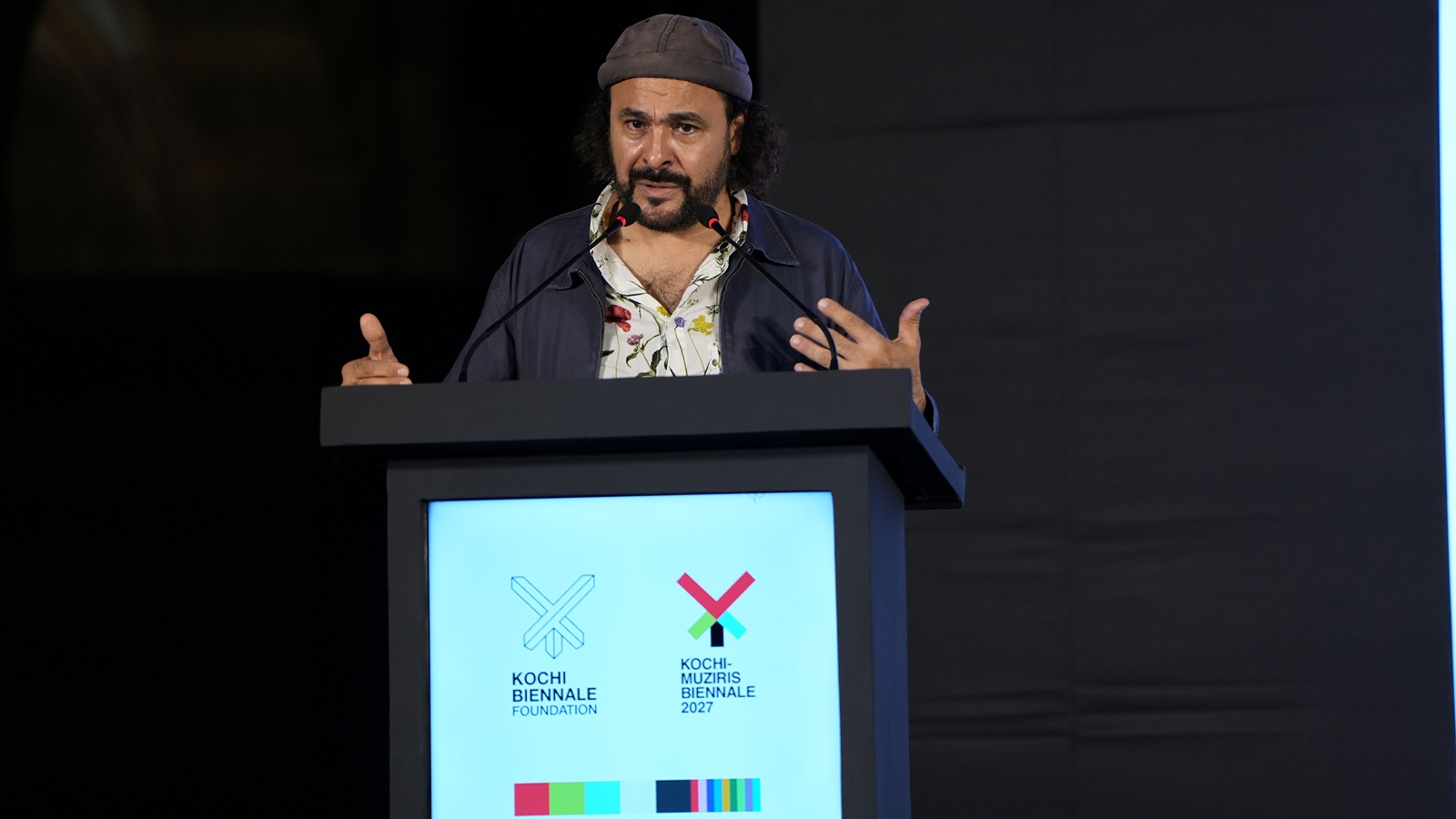
Attia, who presented his curatorial proposition for the seventh edition of the Kochi-Muziris Biennale (KMB) in Mumbai on Saturday, placed dreams, memory and repair at the centre of his vision for the exhibition. KBM’s seventh edition is scheduled to open on December 12, 2027.
The proposition was unveiled at Chhatrapati Shivaji Maharaj Vastu Sangrahalaya (CSMVS) at an event organised by the Kochi Biennale Foundation (KBF).
Attia’s presentation began with dreams and the memory traces from which they emerge. He spoke on how individual identities and external social structures are shaped through a constant exchange of memories.
Tracing humanity’s evolution, he observed that human beings, despite being physically weaker than several other species, survived by gathering and sharing knowledge culturally, materially and intellectually through technology. This is deeply paradoxical, he pointed out, because as technology became more powerful, the less control humanity had over it.
Drawing attention to the tensions of the present, Attia pointed to how algorithmic learning machines and AI harvest our memory traces to feed the attention economy. In the digital realm, he argued, we are steadily losing sovereignty over the sources of our dreams.
Grounding these ideas in Kerala’s history, Attia spoke of Kochi’s harbour as a gateway to the Indian Ocean, bringing centuries of exchange, invasion and colonial encounters, including Portuguese, Dutch and British influences, which shaped the region’s hybrid identity.
Citing Gabonese sociologist Joseph Tonda’s Afrodystopia: Life in Someone Else’s Dream, he reflected on how descendants of colonised subjects continue to live in the ‘dream of the empire’. However, he pointed to the possibility of reclaiming individual identity, recalling Rokeya Sakhawat Hossain’s Sultana’s Dream, which imagines a reversal of patriarchal power through dreams.
“The art world is one of the last spaces where society co-individuates itself,” Attia said, describing exhibitions as important sites that produce emotions and activate new memory traces. “That is how we produce traces for the future. In the same way, we are the traces of our ancestors and of the millions of anonymous subjects who preceded us.”
Responding to a question on the political dimension of dreaming, he said, he was interested in examining political questions through poetry, and exploring how political art could possess poetry and vice versa.
Jitish Kallat, President, KMB, said Attia’s proposition asks who owns our dreams at a time when much of our inner life is being captured, simulated and predicted. “Kochi, a port shaped by centuries of crossings, gives that question a particular inflection,” he said.