

In last moments, mother held son in tight embrace: Tragic sight awaited Madhya Pradesh boat accident rescuers
Survivors recount worsening weather, boat filling with water and rising panic as leisure cruise quickly turned into nightmare.
The bodies were found locked together, mother and child still in an unbroken embrace.
“We initially encountered difficulty retrieving the body of a woman from the wreckage,” one diver said, adding, “Then we realised she was holding her child tightly. It was difficult to separate them. Our team was deeply moved by the scene.”
By Friday morning, the scene had come to define the cruise boat tragedy in the Bargi Dam area near Jabalpur in Madhya Pradesh, where at least nine people have now been confirmed dead.
What began as a leisure cruise on the Narmada reservoir has, in less than 24 hours, unravelled into a tragedy, a story of missed warnings, delayed safety responses and a rescue operation racing against time and terrain.
“This morning, five more people were recovered. Yesterday, 22 people were rescued. In total, 31 people were involved,” said state Tourism Minister Dharmendra Lodhi, as divers continued to search the submerged vessel.
For those who survived, the disaster did not strike as a single moment, but as a slow, visible unravelling. Delhi resident Sangeeta Kori remembers the shift in the air first — the wind picking up, the water turning restless. “Around 6 pm, the wind became strong and water started entering the boat,” she said. What followed, she alleged, was not a coordinated evacuation but a scramble. Life jackets, she said, had not been issued at the start. “They were kept somewhere inside. When water started coming in, they (the crew) began distributing them. That led to panic and scuffles. Within moments, the boat overturned.”
She claimed the vessel was carrying close to 40 people, including children without tickets, even though officials said the number was closer to 30. More troubling, she alleged, were warnings that went unheeded. Locals on the banks, she recalled, had signalled to the operator to turn back as the weather worsened. “He didn’t listen. He seemed inexperienced,” she said.
Another survivor, Tanishka Sen, described how normalcy gave way to chaos within minutes. There had been music and dancing on the boat earlier in the day, she said, before rain forced passengers below deck. Then came the wind. “A sudden wave came, and the boat overturned. People were shouting for help. The waves kept coming, and no one could swim. It felt like something was pulling us down,” she said. Life jackets were eventually worn, but only at the last moment. Her mother, Jyoti Sen, did not survive.
Riyaz Hussain’s account captures the disorientation that followed. For nearly half an hour, he said, the ride had been uneventful before the rain intensified. “The cruise began rocking badly. The pilot tried to manoeuvre it toward the shore for over an hour,” he said. “The crew gave everyone life jackets, but the waves began entering the boat. Then I remember darkness. Everything went quiet.” Hussain survived hours in the water with his son; his wife remains missing.
Minister Lodhi maintained that life jackets were provided and that there is a clear rule requiring passengers to wear them. “Now that allegations are being made, we will conduct an investigation. If any negligence is found, strict action will be taken,” he said.
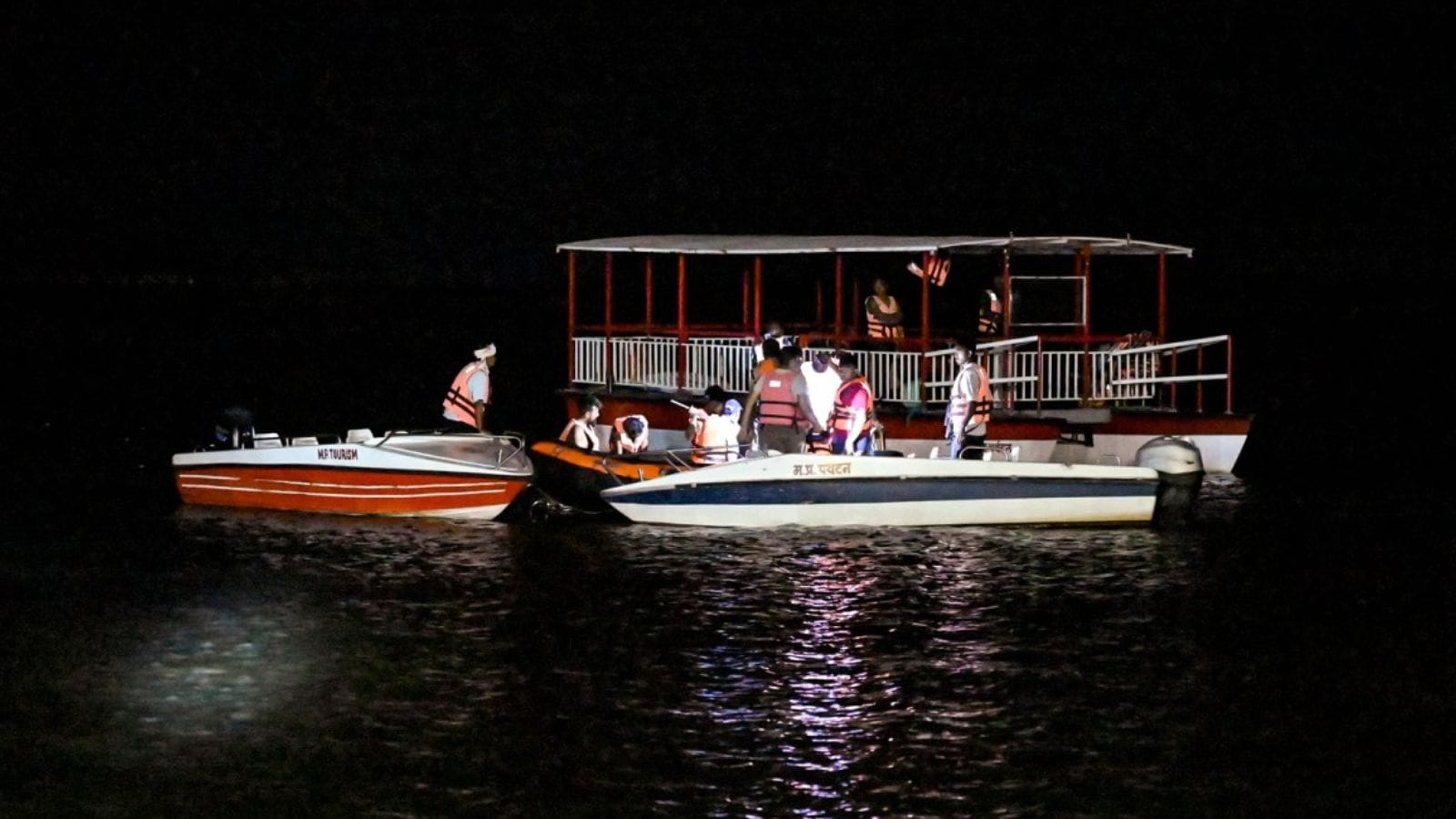
Even as these questions gather force, the rescue effort has evolved into a technically complex retrieval operation. Through the night, teams from the SDRF and police navigated rain, darkness and rocky terrain to locate the wreck. By Friday morning, an 11-member Army Grenadiers unit had joined the effort, alongside NDRF divers, turning the search into a coordinated, multi-agency exercise.
Hydraulic systems were deployed to stabilise parts of the riverbed and create access to the submerged hull. Heavy machinery — Poclain excavators and cranes — was used to fasten thick steel cables to the wreck, which has been dragged nearly 30 metres toward the bank. Progress, however, has been slow, hampered by underwater resistance and depth.
“Yesterday evening, around 6.30 pm, we received information that a cruise was sinking,” said Commandant Neeraj Singh, who is overseeing operations. “By the time we reached, it was dark and raining. We conducted search operations through the night, but deep diving was not possible then. In the morning, as conditions improved, we began coordinated deep diving with the Army and NDRF. Around 60 to 70 personnel were deployed. The rocky terrain created significant difficulties,” he said.
It was during these deep dives that teams finally reached the submerged interiors of the vessel, recovering bodies from within the wreckage, including those trapped in confined sections of the boat.
Stay updated with the latest - Click here to follow us on Instagram
The bodies were found locked together, mother and child still in an unbroken embrace.
“We initially encountered difficulty retrieving the body of a woman from the wreckage,” one diver said, adding, “Then we realised she was holding her child tightly. It was difficult to separate them. Our team was deeply moved by the scene.”
By Friday morning, the scene had come to define the cruise boat tragedy in the Bargi Dam area near Jabalpur in Madhya Pradesh, where at least nine people have now been confirmed dead.
What began as a leisure cruise on the Narmada reservoir has, in less than 24 hours, unravelled into a tragedy, a story of missed warnings, delayed safety responses and a rescue operation racing against time and terrain.
“This morning, five more people were recovered. Yesterday, 22 people were rescued. In total, 31 people were involved,” said state Tourism Minister Dharmendra Lodhi, as divers continued to search the submerged vessel.
For those who survived, the disaster did not strike as a single moment, but as a slow, visible unravelling. Delhi resident Sangeeta Kori remembers the shift in the air first — the wind picking up, the water turning restless. “Around 6 pm, the wind became strong and water started entering the boat,” she said. What followed, she alleged, was not a coordinated evacuation but a scramble. Life jackets, she said, had not been issued at the start. “They were kept somewhere inside. When water started coming in, they (the crew) began distributing them. That led to panic and scuffles. Within moments, the boat overturned.”
She claimed the vessel was carrying close to 40 people, including children without tickets, even though officials said the number was closer to 30. More troubling, she alleged, were warnings that went unheeded. Locals on the banks, she recalled, had signalled to the operator to turn back as the weather worsened. “He didn’t listen. He seemed inexperienced,” she said.
Another survivor, Tanishka Sen, described how normalcy gave way to chaos within minutes. There had been music and dancing on the boat earlier in the day, she said, before rain forced passengers below deck. Then came the wind. “A sudden wave came, and the boat overturned. People were shouting for help. The waves kept coming, and no one could swim. It felt like something was pulling us down,” she said. Life jackets were eventually worn, but only at the last moment. Her mother, Jyoti Sen, did not survive.
Riyaz Hussain’s account captures the disorientation that followed. For nearly half an hour, he said, the ride had been uneventful before the rain intensified. “The cruise began rocking badly. The pilot tried to manoeuvre it toward the shore for over an hour,” he said. “The crew gave everyone life jackets, but the waves began entering the boat. Then I remember darkness. Everything went quiet.” Hussain survived hours in the water with his son; his wife remains missing.
Minister Lodhi maintained that life jackets were provided and that there is a clear rule requiring passengers to wear them. “Now that allegations are being made, we will conduct an investigation. If any negligence is found, strict action will be taken,” he said.
Even as these questions gather force, the rescue effort has evolved into a technically complex retrieval operation. Through the night, teams from the SDRF and police navigated rain, darkness and rocky terrain to locate the wreck. By Friday morning, an 11-member Army Grenadiers unit had joined the effort, alongside NDRF divers, turning the search into a coordinated, multi-agency exercise.
Hydraulic systems were deployed to stabilise parts of the riverbed and create access to the submerged hull. Heavy machinery — Poclain excavators and cranes — was used to fasten thick steel cables to the wreck, which has been dragged nearly 30 metres toward the bank. Progress, however, has been slow, hampered by underwater resistance and depth.
“Yesterday evening, around 6.30 pm, we received information that a cruise was sinking,” said Commandant Neeraj Singh, who is overseeing operations. “By the time we reached, it was dark and raining. We conducted search operations through the night, but deep diving was not possible then. In the morning, as conditions improved, we began coordinated deep diving with the Army and NDRF. Around 60 to 70 personnel were deployed. The rocky terrain created significant difficulties,” he said.
It was during these deep dives that teams finally reached the submerged interiors of the vessel, recovering bodies from within the wreckage, including those trapped in confined sections of the boat.