

Mumbai-Ahmedabad bullet train project: Third mountain tunnel breakthrough achieved in Palghar
The National High Speed Rail Corporation Limited (NHSRCL) has successfully achieved its fourth overall tunnel breakthrough for the 508-km rail corridor.
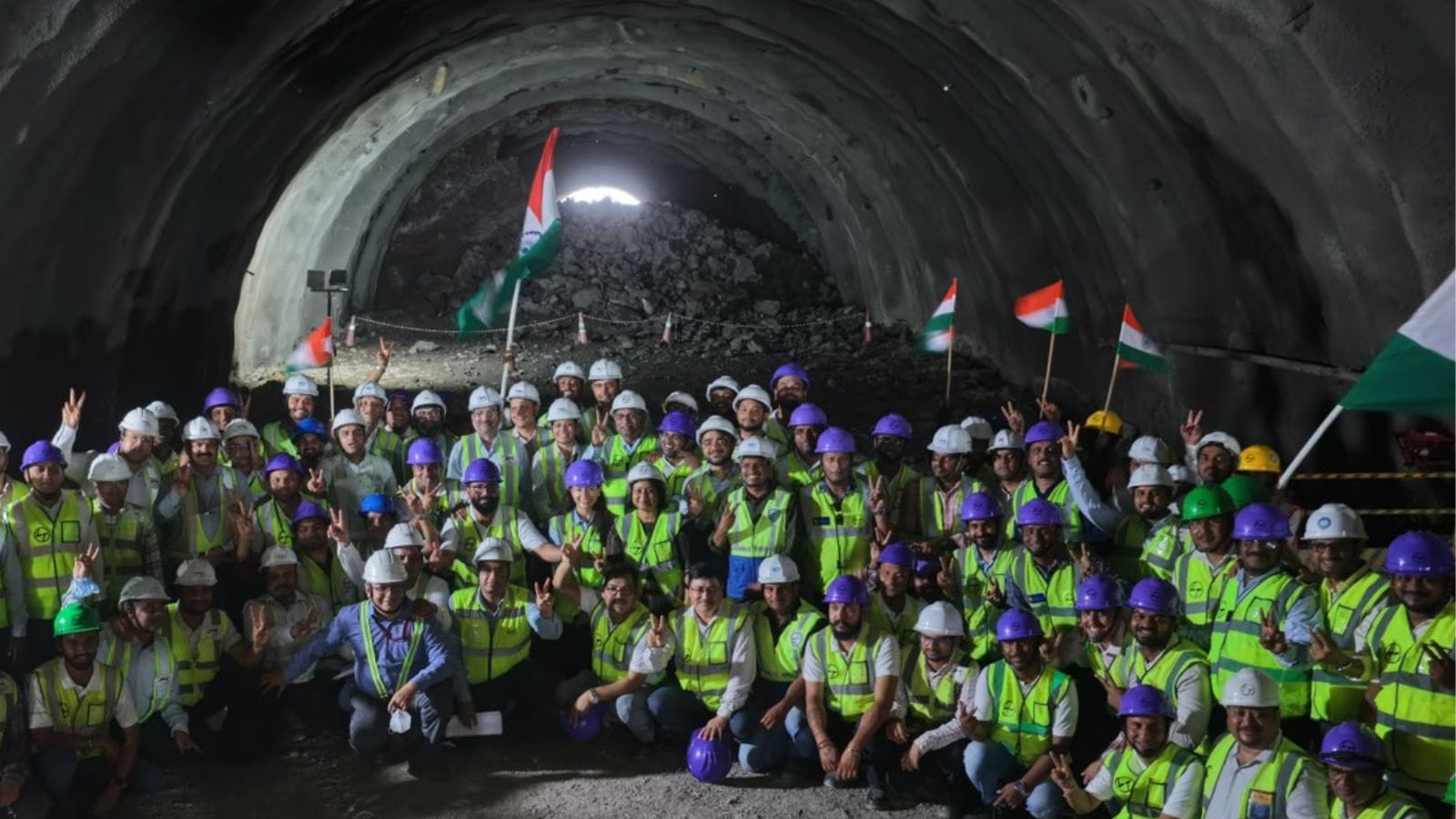
The Mumbai-Ahmedabad High-Speed Rail (MAHSR) corridor, India’s first bullet train project, achieved a major breakthrough at its third mountain tunnel (and fourth tunnel overall) in Maharashtra’s Palghar district Tuesday. This marks a critical milestone for the project, as these mountain tunnels are among the most challenging stretches of the entire 508-km corridor.
The mountain tunnel number 7 (MT-7) is situated between Vapi and Boisar stations, measuring 417 metres in length and 14 metres in width. Officials said the breakthrough was achieved in Ambesari village in Dahanu taluka of Palghar district. Earlier, breakthroughs were achieved at tunnels 8 and 6 between the Vapi and Boisar stations.
A tunnel breakthrough occurs when excavation carried out from opposite ends finally connects, marking the successful completion of the structural work.
“The excavation was carried out using the controlled drilling and blasting method from both ends. Advanced monitoring systems and geotechnical instruments were deployed throughout the excavation process to ensure structural stability and safety,” said an official of National High Speed Rail Corporation Limited (NHSRCL), the implementing agency of the project.
Tunnels account for 27.4 km in the bullet train project. This includes 21 km of underground tunnels, with the remaining 6.4 km comprised of surface tunnels. The surface tunnels feature eight mountain tunnels; seven of these are located in Palghar, Maharashtra, covering a distance of 6.05 km, while one tunnel, measuring 350 metres, is in Gujarat.
The official further said that real-time monitoring systems, including Surface Settlement Points (SSP), 3D targets, strain gauges, and seismographs, were installed to continuously monitor vibrations, tunnel behaviour, and nearby structures during excavation activities.
Officials said that tunnels MT-4, MT-3, MT-2, and MT-1 are making significant progress, with MT-4 nearing 60 per cent completion, MT-3 exceeding 80 per cent excavation, and the other two tunnels progressing steadily.
The bullet train project covers 352 km in Gujarat and Dadra and Nagar Haveli, and 156 km in Maharashtra. As of March 2026, the project achieved 68.19 per cent physical progress in Gujarat and 40.66 per cent progress in Maharashtra.
The first section of the bullet train project from Surat to Bilimora in Gujarat is scheduled to be ready by August 15, 2027. The entire 508-km project is expected to be completed by December 2029.
Stay updated with the latest - Click here to follow us on Instagram
The Mumbai-Ahmedabad High-Speed Rail (MAHSR) corridor, India’s first bullet train project, achieved a major breakthrough at its third mountain tunnel (and fourth tunnel overall) in Maharashtra’s Palghar district Tuesday. This marks a critical milestone for the project, as these mountain tunnels are among the most challenging stretches of the entire 508-km corridor.
The mountain tunnel number 7 (MT-7) is situated between Vapi and Boisar stations, measuring 417 metres in length and 14 metres in width. Officials said the breakthrough was achieved in Ambesari village in Dahanu taluka of Palghar district. Earlier, breakthroughs were achieved at tunnels 8 and 6 between the Vapi and Boisar stations.
A tunnel breakthrough occurs when excavation carried out from opposite ends finally connects, marking the successful completion of the structural work.
“The excavation was carried out using the controlled drilling and blasting method from both ends. Advanced monitoring systems and geotechnical instruments were deployed throughout the excavation process to ensure structural stability and safety,” said an official of National High Speed Rail Corporation Limited (NHSRCL), the implementing agency of the project.
Tunnels account for 27.4 km in the bullet train project. This includes 21 km of underground tunnels, with the remaining 6.4 km comprised of surface tunnels. The surface tunnels feature eight mountain tunnels; seven of these are located in Palghar, Maharashtra, covering a distance of 6.05 km, while one tunnel, measuring 350 metres, is in Gujarat.
The official further said that real-time monitoring systems, including Surface Settlement Points (SSP), 3D targets, strain gauges, and seismographs, were installed to continuously monitor vibrations, tunnel behaviour, and nearby structures during excavation activities.
Officials said that tunnels MT-4, MT-3, MT-2, and MT-1 are making significant progress, with MT-4 nearing 60 per cent completion, MT-3 exceeding 80 per cent excavation, and the other two tunnels progressing steadily.
The bullet train project covers 352 km in Gujarat and Dadra and Nagar Haveli, and 156 km in Maharashtra. As of March 2026, the project achieved 68.19 per cent physical progress in Gujarat and 40.66 per cent progress in Maharashtra.
The first section of the bullet train project from Surat to Bilimora in Gujarat is scheduled to be ready by August 15, 2027. The entire 508-km project is expected to be completed by December 2029.