

‘Acts of terror will have consequences’: India’s top military brass issues stern warning on Operation Sindoor anniversary
On the first anniversary of Operation Sindoor, the tri-service leadership cautioned adversaries that any future misadventures will face "sustained overmatch".
Marking the first anniversary of Operation Sindoor, India’s top military leadership delivered a stern warning to adversaries Thursday, asserting that it has set a permanent template for responding to cross-border provocations.
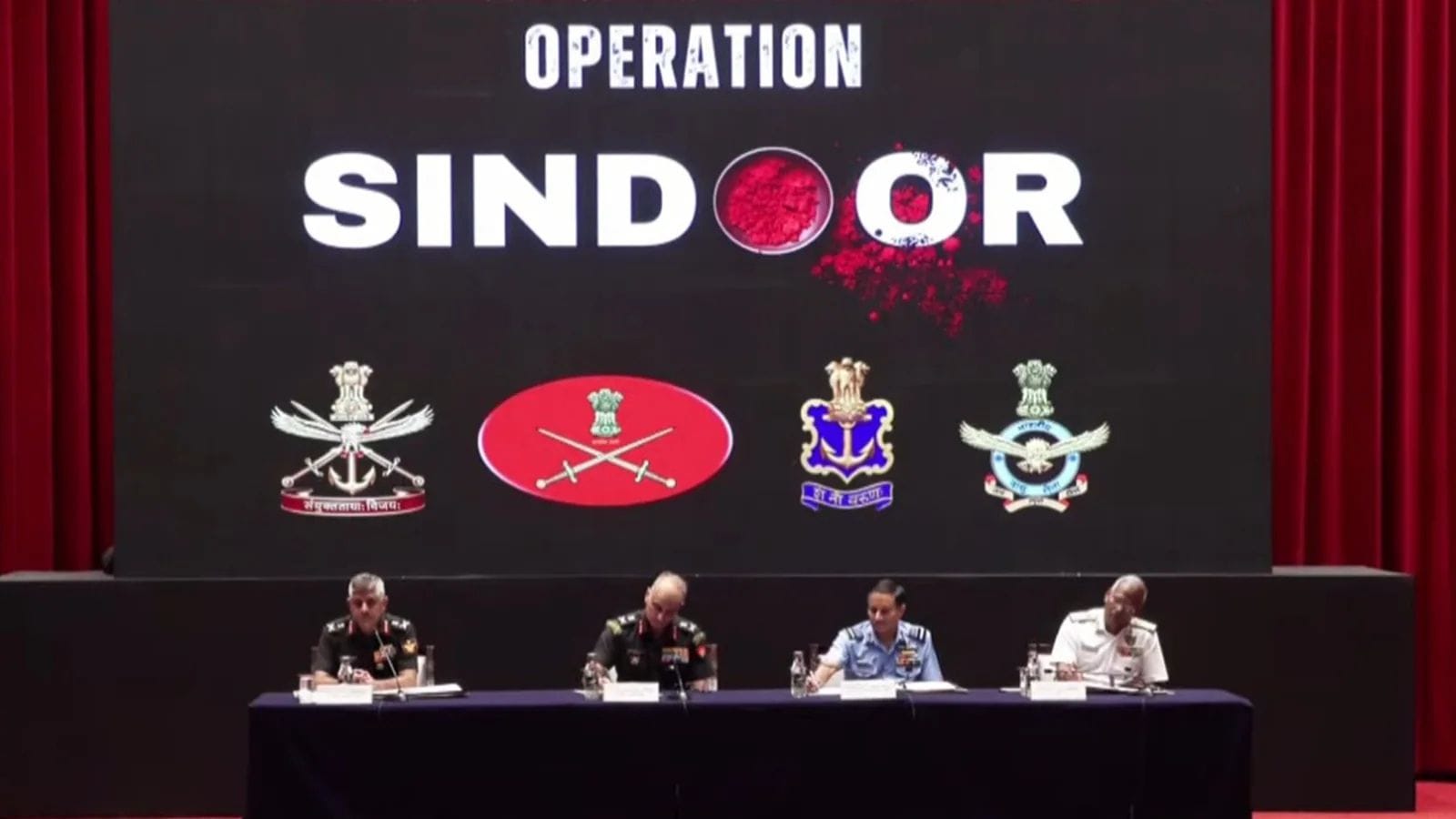
In a tri-services joint media address in Jaipur, Air Marshal A K Bharti, Deputy Chief of Air Staff, declared that the mission sent a definitive message: “Misadventures will not go unanswered, and acts of terror will have consequences.”
Air Marshal Bharti, who served as the Director General (DG) of Air Operations during the strikes, was joined by Lt Gen Rajiv Ghai (Deputy Chief of Army Staff), Vice Admiral AN Pramod (DG Naval Operations), and Lt Gen Zubin Minwalla (Deputy Chief of Integrated Defence Staff).
Recalling the operation launched on May 7 last year in response to the Pahalgam terror attack, which killed 26 people, and the planning that went behind it, Air Marshal Bharti said, “The objective was clear, and the forces were given full operational freedom.”
“The COSC (Committee of Service Chiefs), which comprises the CDS and the three service chiefs, deliberated every option and calibrated every decision. Thus, with an absolute clarity of action, a successful joint operation was launched to destroy the terror infrastructure in PoK as well as in Pakistan itself,” he said.
“The three of us met almost daily, and on more than one occasion, our aim was not just to hit. It had to be lethal. It had to be precise, avoiding collateral. Hence, the selection of targets, timing, and weapons to be used, everything needed to be carefully considered,” he added.
Air Marshal Bharti said the target was the terrorists and their support infrastructure, ensuring no collateral damage occurred. “We achieved our objectives, and our mission was complete. But when the Pakistani establishment decided to side with terror and make it their own fight, we had no choice but to respond in kind. It was about self-defence, much beyond a counter-terror operation,” he said.
He added, “When we responded, it was lethal and ruthless. After taking the beating, sense kicked in in the adversary, and they asked for a cessation of hostilities. We paused when the request came. We stepped back but we didn’t blink.”
Lt Gen Ghai said Operation Sindoor saw India very consciously and coherently go beyond its erstwhile approaches and methods and target terror infrastructure across the Line of Control (LoC) and the international boundary with Pakistan. He, however, cautioned that Operation Sindoor was not an end.
“It was just the beginning. India’s fight against terror will go on. A year on, we remember not just the operation but also the principle behind it. India will defend its sovereignty, its security, and its people decisively, professionally and with the utmost responsibility,” he said.
The senior officers agreed that Operation Sindoor was a joint tri-service effort, integrating land, air, and maritime capabilities with shared situational awareness, common operations, intelligence pictures, and real-time decision-making.
Lt Gen Ghai also said that a significant percentage of the weapon systems, munitions, rockets and missiles, sensors, and electronic warfare systems employed were developed and produced in India.
“The BrahMos, Akash, advanced surveillance and targeting systems, along with homegrown ammunition and spares, all played a decisive role. Indigenous equipment meant not only self-reliance but the flexibility to tailor these to our operational requirements, sustain and maintain supply chains and to respond with speed and confidence,” he said.
He further said the objectives were achieved through a calibrated shot and sharp shock that altered the enemy’s risk appetite and disrupted his command and control without locking India into a long-drawn war or conflict, the ill effects of which we are seeing in ongoing conflicts around the world.
“The operation placed enormous responsibility on every arm of the state. Intelligence agencies provided accurate information, which is so critical to precision targeting. Cyber and electronic warfare units maintained information dominance,” he said, adding the government managed the international environment as well as the internal security and public reassurance.
“The armed forces executed the kinetic phase with discipline, precision and minimal collateral impact. This multi-agency, multi-domain coordination will remain the template for future operations,” Lt Gen Ghai said.
Responding to questions on losses on both sides, Air Marshal Bharti said that Pakistan had not been able to inflict any major damage on the Indian side.
“Neither any military infrastructure nor much of the civilian structures. Whatever they may say, remember narratives and rhetoric do not give you victory. Victory is measured by hard facts.”
“We struck and decimated their nine terrorist camps on May 7. The proof is there for everybody to see. We struck 11 of their airfields. We destroyed 13 of their aircraft either on the ground or in the air, including one high-value airborne asset at a record distance of 300 kilometres plus,” he said.
Vice Admiral A N Pramod said that by striking the terror hubs in the heart of Pakistan using long-range precision weapons, India effectively called the bluff on Pakistan’s “nuclear blackmail”.
Recalling the operation, he said that as the campaign unfolded, the Indian Navy’s forward deployment compelled Pakistani naval and air units to adopt a defensive posture, largely confined to harbours or operating close to their coastline.
“Operation Sindoor validated India’s ability to respond to asymmetric provocation with deliberate, precise and proportionate force. It demonstrated that terror infrastructure and supporting military enablers can be targeted swiftly and effectively whilst maintaining escalation dominance,” he said.
“The operation also highlighted the decisive role of indigenous cutting-edge technologies, platforms, systems and equipment, including drones, layer defence systems and counter-uncrewed aerial systems,” he added.
“The growing relevance of uncrewed and autonomous systems as seen in the recent conflicts, reinforces the need for accelerated integration into our operational constructs,” he said.
He said the endeavour remains focused on inducting these niche capabilities and constantly reviewing the concepts of operations to stay ahead of the adversary.
“If Operation Sindoor was proof of calibrated resolve, our next response will be about sustained overmatch. If challenged again, we will not merely respond; we will shape the battle space from the outset,” he said.
Stay updated with the latest - Click here to follow us on Instagram
Marking the first anniversary of Operation Sindoor, India’s top military leadership delivered a stern warning to adversaries Thursday, asserting that it has set a permanent template for responding to cross-border provocations.
In a tri-services joint media address in Jaipur, Air Marshal A K Bharti, Deputy Chief of Air Staff, declared that the mission sent a definitive message: “Misadventures will not go unanswered, and acts of terror will have consequences.”
Air Marshal Bharti, who served as the Director General (DG) of Air Operations during the strikes, was joined by Lt Gen Rajiv Ghai (Deputy Chief of Army Staff), Vice Admiral AN Pramod (DG Naval Operations), and Lt Gen Zubin Minwalla (Deputy Chief of Integrated Defence Staff).
Recalling the operation launched on May 7 last year in response to the Pahalgam terror attack, which killed 26 people, and the planning that went behind it, Air Marshal Bharti said, “The objective was clear, and the forces were given full operational freedom.”
“The COSC (Committee of Service Chiefs), which comprises the CDS and the three service chiefs, deliberated every option and calibrated every decision. Thus, with an absolute clarity of action, a successful joint operation was launched to destroy the terror infrastructure in PoK as well as in Pakistan itself,” he said.
“The three of us met almost daily, and on more than one occasion, our aim was not just to hit. It had to be lethal. It had to be precise, avoiding collateral. Hence, the selection of targets, timing, and weapons to be used, everything needed to be carefully considered,” he added.
Air Marshal Bharti said the target was the terrorists and their support infrastructure, ensuring no collateral damage occurred. “We achieved our objectives, and our mission was complete. But when the Pakistani establishment decided to side with terror and make it their own fight, we had no choice but to respond in kind. It was about self-defence, much beyond a counter-terror operation,” he said.
He added, “When we responded, it was lethal and ruthless. After taking the beating, sense kicked in in the adversary, and they asked for a cessation of hostilities. We paused when the request came. We stepped back but we didn’t blink.”
Lt Gen Ghai said Operation Sindoor saw India very consciously and coherently go beyond its erstwhile approaches and methods and target terror infrastructure across the Line of Control (LoC) and the international boundary with Pakistan. He, however, cautioned that Operation Sindoor was not an end.
“It was just the beginning. India’s fight against terror will go on. A year on, we remember not just the operation but also the principle behind it. India will defend its sovereignty, its security, and its people decisively, professionally and with the utmost responsibility,” he said.
The senior officers agreed that Operation Sindoor was a joint tri-service effort, integrating land, air, and maritime capabilities with shared situational awareness, common operations, intelligence pictures, and real-time decision-making.
Lt Gen Ghai also said that a significant percentage of the weapon systems, munitions, rockets and missiles, sensors, and electronic warfare systems employed were developed and produced in India.
“The BrahMos, Akash, advanced surveillance and targeting systems, along with homegrown ammunition and spares, all played a decisive role. Indigenous equipment meant not only self-reliance but the flexibility to tailor these to our operational requirements, sustain and maintain supply chains and to respond with speed and confidence,” he said.
He further said the objectives were achieved through a calibrated shot and sharp shock that altered the enemy’s risk appetite and disrupted his command and control without locking India into a long-drawn war or conflict, the ill effects of which we are seeing in ongoing conflicts around the world.
“The operation placed enormous responsibility on every arm of the state. Intelligence agencies provided accurate information, which is so critical to precision targeting. Cyber and electronic warfare units maintained information dominance,” he said, adding the government managed the international environment as well as the internal security and public reassurance.
“The armed forces executed the kinetic phase with discipline, precision and minimal collateral impact. This multi-agency, multi-domain coordination will remain the template for future operations,” Lt Gen Ghai said.
Responding to questions on losses on both sides, Air Marshal Bharti said that Pakistan had not been able to inflict any major damage on the Indian side.
“Neither any military infrastructure nor much of the civilian structures. Whatever they may say, remember narratives and rhetoric do not give you victory. Victory is measured by hard facts.”
“We struck and decimated their nine terrorist camps on May 7. The proof is there for everybody to see. We struck 11 of their airfields. We destroyed 13 of their aircraft either on the ground or in the air, including one high-value airborne asset at a record distance of 300 kilometres plus,” he said.
Vice Admiral A N Pramod said that by striking the terror hubs in the heart of Pakistan using long-range precision weapons, India effectively called the bluff on Pakistan’s “nuclear blackmail”.
Recalling the operation, he said that as the campaign unfolded, the Indian Navy’s forward deployment compelled Pakistani naval and air units to adopt a defensive posture, largely confined to harbours or operating close to their coastline.
“Operation Sindoor validated India’s ability to respond to asymmetric provocation with deliberate, precise and proportionate force. It demonstrated that terror infrastructure and supporting military enablers can be targeted swiftly and effectively whilst maintaining escalation dominance,” he said.
“The operation also highlighted the decisive role of indigenous cutting-edge technologies, platforms, systems and equipment, including drones, layer defence systems and counter-uncrewed aerial systems,” he added.
“The growing relevance of uncrewed and autonomous systems as seen in the recent conflicts, reinforces the need for accelerated integration into our operational constructs,” he said.
He said the endeavour remains focused on inducting these niche capabilities and constantly reviewing the concepts of operations to stay ahead of the adversary.
“If Operation Sindoor was proof of calibrated resolve, our next response will be about sustained overmatch. If challenged again, we will not merely respond; we will shape the battle space from the outset,” he said.