

Pakistan must decide if it wants to be part of geography or history or not: Army Chief
The Army Chief's comments came days after India marked the first anniversary of Operation Sindoor.
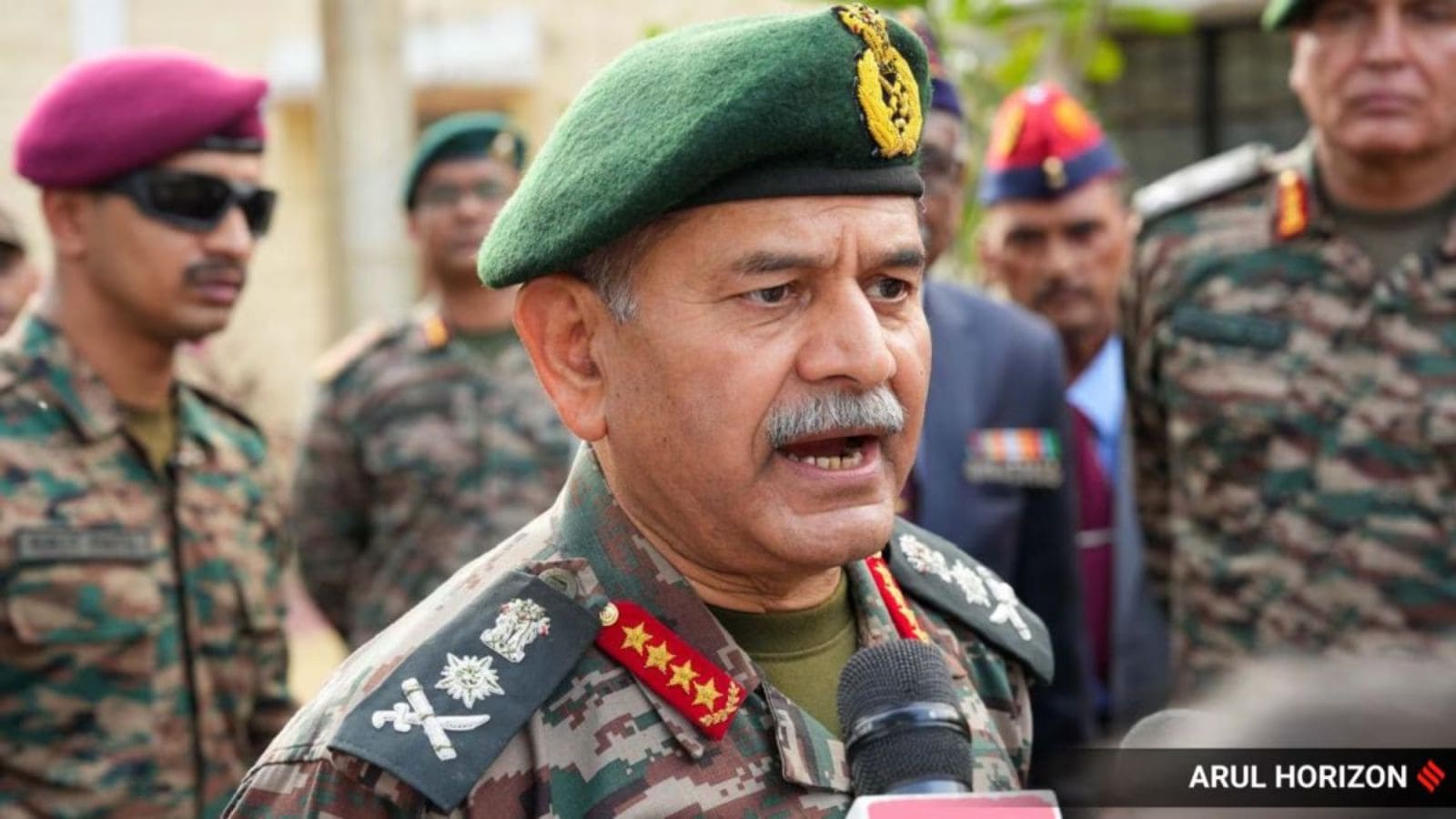
In a warning to Pakistan on Saturday, Army Chief General Upendra Dwivedi said that if it continues to “harbour terrorists and operate against India”, it will have to decide whether it wants “to be part of geography or history or not”.
Speaking at the ‘Sena Samwad’ event here, he was responding to a question on the Army’s response if the circumstances that led to Operation Sindoor last year arise again.
“If you have heard me earlier, what I have said… that Pakistan, if it continues to harbour terrorists and operate against India, then they have to decide whether they want to be part of geography or history or not,” he said.
The Army Chief’s comments came days after India marked the first anniversary of Operation Sindoor. This is the second such remark he has made since Operation Sindoor last year.
Last year, he told soldiers that if Pakistan wants to remain on the world map, it would have to stop sponsoring terrorism on its soil, adding that India would not show any restraint it showed last time.
On Saturday, the Army Chief also said the military is undergoing rapid changes and modernisation, causing technology to become obsolete within 18 months.
“If you have to adapt to that kind of technology, how are you going about it? Therefore, the ripples of change have to be felt at every level, starting from a soldier to a major to a major general, till a general like me…When you look at the big picture, a whole-of-nation approach, how are you going to converge this complete India as a nation to fight a war? How are you going to establish the interlinkages? How are you going to provide the strategic guidance to the decision makers?” he said.
“Those are the big things that we are looking at while making sure that your halo effect and the reputation which you have made over a period of time comes down to a soldier or to a common citizen who is part of the whole-of-the-nation approach whenever you go for the next operations or war,” he said.
He also said that as far as the Indian Army is concerned, there is leadership at every level.
Stating that indigenisation is a gradual process, he said: “Because for a soldier, whatever is best will be provided. Now we have reached a very high standard of indigenisation. Because the best weaponry of a particular kind is being manufactured in India. There are changes as far as the present-day battlefield is concerned, and the future battlefield is concerned,” he said.
The Army Chief's remarks come at a time when former Army generals and retired diplomats from both India and Pakistan have met at least twice in the last three months. While these are not formal “back-channels of communication”, this is the first such engagement since Operation Sindoor.
“The present-day battlefield, if you see, is more related to the first three domains: land, maritime, and air. Now these three domains have to give space to the three different domains: cyber, space and the cognitive. But it doesn’t mean the first three domains will go away,” he said.
He said the future of warfare would be more challenging because all this has to be put into somebody’s brain. “And your generation will definitely be better off than us. Because in our case, artificial intelligence, we knew the definition, but you know the application. That’s the biggest difference,” he said.
Stay updated with the latest - Click here to follow us on Instagram
In a warning to Pakistan on Saturday, Army Chief General Upendra Dwivedi said that if it continues to “harbour terrorists and operate against India”, it will have to decide whether it wants “to be part of geography or history or not”.
Speaking at the ‘Sena Samwad’ event here, he was responding to a question on the Army’s response if the circumstances that led to Operation Sindoor last year arise again.
“If you have heard me earlier, what I have said… that Pakistan, if it continues to harbour terrorists and operate against India, then they have to decide whether they want to be part of geography or history or not,” he said.
The Army Chief’s comments came days after India marked the first anniversary of Operation Sindoor. This is the second such remark he has made since Operation Sindoor last year.
Last year, he told soldiers that if Pakistan wants to remain on the world map, it would have to stop sponsoring terrorism on its soil, adding that India would not show any restraint it showed last time.
On Saturday, the Army Chief also said the military is undergoing rapid changes and modernisation, causing technology to become obsolete within 18 months.
“If you have to adapt to that kind of technology, how are you going about it? Therefore, the ripples of change have to be felt at every level, starting from a soldier to a major to a major general, till a general like me…When you look at the big picture, a whole-of-nation approach, how are you going to converge this complete India as a nation to fight a war? How are you going to establish the interlinkages? How are you going to provide the strategic guidance to the decision makers?” he said.
“Those are the big things that we are looking at while making sure that your halo effect and the reputation which you have made over a period of time comes down to a soldier or to a common citizen who is part of the whole-of-the-nation approach whenever you go for the next operations or war,” he said.
He also said that as far as the Indian Army is concerned, there is leadership at every level.
Stating that indigenisation is a gradual process, he said: “Because for a soldier, whatever is best will be provided. Now we have reached a very high standard of indigenisation. Because the best weaponry of a particular kind is being manufactured in India. There are changes as far as the present-day battlefield is concerned, and the future battlefield is concerned,” he said.
The Army Chief's remarks come at a time when former Army generals and retired diplomats from both India and Pakistan have met at least twice in the last three months. While these are not formal “back-channels of communication”, this is the first such engagement since Operation Sindoor.
“The present-day battlefield, if you see, is more related to the first three domains: land, maritime, and air. Now these three domains have to give space to the three different domains: cyber, space and the cognitive. But it doesn’t mean the first three domains will go away,” he said.
He said the future of warfare would be more challenging because all this has to be put into somebody’s brain. “And your generation will definitely be better off than us. Because in our case, artificial intelligence, we knew the definition, but you know the application. That’s the biggest difference,” he said.