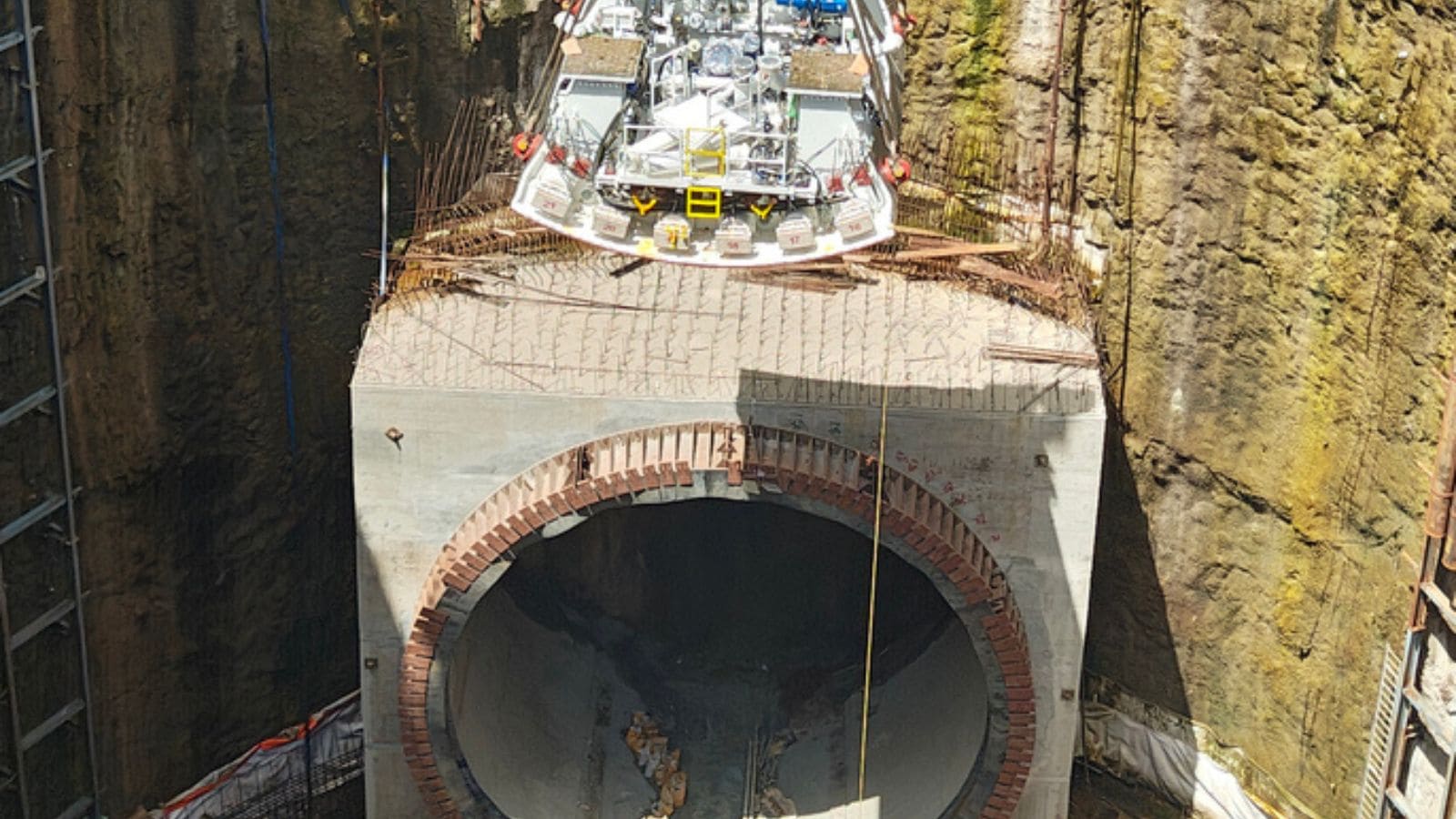


NHSRCL start assembling TBM for Mumbai’s 21-km bullet train tunnel, 97 days to go for completion
Officials said that the tunnel will be a single tube tunnel of 13.1 meter diameter to accommodate twin track.
In an important development in Mumbai-Ahmedabad Bullet Train Project, the assembling of crucial one of the two tunnel boring machines (TBMs) for a 21-km long underground tunnel in Mumbai started on Thursday. It will take at least 97 days to complete the assembling and make it ready for the excavation.
The underground tunnel between Bandra Kurla Complex (BKC) and Shilphata in Mumbai is one of the most difficult section of the entire 508-km Mumbai-Ahmedabad High Speed Rail (MAHSR), which includes India’s first 7 km long undersea tunnel beneath Thane Creek and excavation under many residential building of the city. Out of 21 kms, 5 km tunnel has been excavated through New Austrian Tunneling Method (NATM), which involves blasting, and remaining 16 km tunnel will be excavated through TBMs.
Officials said that the tunnel will be a single tube tunnel of 13.1 meter diameter to accommodate twin track. The tunnel will be about 25 to 57 Meters deep from the ground level and the deepest construction point will be 114 meters below the Parsik hill. The two TBMs has been supplied by the German company Herrenknecht and some of its parts are still in transit from the Jawaharlal Nehru Port to the two sites where they will be deployed – Vikhroli, a suburb of Mumbai, and Savali in Ghansoli area of Navi Mumbai. All the shipments of the TBMs are expected to leave the port by April 12.
“The process began with the lowering of one of the six segments of the main shield, weighing approximately 170 metric tonnes. This segment measures about 8.66 metres in length and approximately 7 metres in width and was lowered at a depth of 56 metres below ground level – equivalent to a 20-storey building, at Vikhroli. Once assembled, the entire machine will be almost 96 meters long,” said a senior official of National High Speed Rail Corporation Limited (NHSRCL), the implementing agency of the project.
The two TBMs, weighing 3080 tons (TBM-1) and 3184 tons (TBM-2) respectively are most advanced tunneling machines deployed in the country. NHSRCL officials said that these advanced TBMs, based on Mix Shield/Slurry technology, are specifically designed to operate in complex geological conditions. A TMB is comprised of several critical components such as cutter wheel, main bearing, jaw crusher, erector, main shield, tail shield, and four specialized gantries that support tunneling operations.
The machine can operate at a maximum cutterhead speed of 4 RPM (revolutions per minute) and can excavate a maximum of 49 mm per minute. “The tunnel will cross under many residential areas, there are around 600 residential buildings which fall along the stretch. The project involves a 7-km undersea tunnel as well. Under such circumstances, tunneling through blasting or NATM is risky. This is why TBMs have been brought, we need a high level of precision,” said a senior official of NHSRCL to The Indian Express earlier.
This is the first time that a semi-automatic TBM will be used in the country. It will carry out drilling and segment deployment at the same time. Currently, in projects where TBMs are used, like the Rishikesh-Karnaprayag rail line, only one task can be performed at a time.
Technical Specifications:
In an important development in Mumbai-Ahmedabad Bullet Train Project, the assembling of crucial one of the two tunnel boring machines (TBMs) for a 21-km long underground tunnel in Mumbai started on Thursday. It will take at least 97 days to complete the assembling and make it ready for the excavation.
The underground tunnel between Bandra Kurla Complex (BKC) and Shilphata in Mumbai is one of the most difficult section of the entire 508-km Mumbai-Ahmedabad High Speed Rail (MAHSR), which includes India’s first 7 km long undersea tunnel beneath Thane Creek and excavation under many residential building of the city. Out of 21 kms, 5 km tunnel has been excavated through New Austrian Tunneling Method (NATM), which involves blasting, and remaining 16 km tunnel will be excavated through TBMs.
Officials said that the tunnel will be a single tube tunnel of 13.1 meter diameter to accommodate twin track. The tunnel will be about 25 to 57 Meters deep from the ground level and the deepest construction point will be 114 meters below the Parsik hill. The two TBMs has been supplied by the German company Herrenknecht and some of its parts are still in transit from the Jawaharlal Nehru Port to the two sites where they will be deployed – Vikhroli, a suburb of Mumbai, and Savali in Ghansoli area of Navi Mumbai. All the shipments of the TBMs are expected to leave the port by April 12.
“The process began with the lowering of one of the six segments of the main shield, weighing approximately 170 metric tonnes. This segment measures about 8.66 metres in length and approximately 7 metres in width and was lowered at a depth of 56 metres below ground level – equivalent to a 20-storey building, at Vikhroli. Once assembled, the entire machine will be almost 96 meters long,” said a senior official of National High Speed Rail Corporation Limited (NHSRCL), the implementing agency of the project.
The two TBMs, weighing 3080 tons (TBM-1) and 3184 tons (TBM-2) respectively are most advanced tunneling machines deployed in the country. NHSRCL officials said that these advanced TBMs, based on Mix Shield/Slurry technology, are specifically designed to operate in complex geological conditions. A TMB is comprised of several critical components such as cutter wheel, main bearing, jaw crusher, erector, main shield, tail shield, and four specialized gantries that support tunneling operations.
The machine can operate at a maximum cutterhead speed of 4 RPM (revolutions per minute) and can excavate a maximum of 49 mm per minute. “The tunnel will cross under many residential areas, there are around 600 residential buildings which fall along the stretch. The project involves a 7-km undersea tunnel as well. Under such circumstances, tunneling through blasting or NATM is risky. This is why TBMs have been brought, we need a high level of precision,” said a senior official of NHSRCL to The Indian Express earlier.
This is the first time that a semi-automatic TBM will be used in the country. It will carry out drilling and segment deployment at the same time. Currently, in projects where TBMs are used, like the Rishikesh-Karnaprayag rail line, only one task can be performed at a time.
Technical Specifications: